
Introduction
Modern SaaS products frequently fail because users are overwhelmed by complicated interfaces or frustrated by limited functionality. As a result, even powerful platforms experience reduced adoption, retention, and trust.
However, UI and UX design can address this issue by creating interfaces that appear simple on the surface while providing powerful capabilities beneath. When executed correctly, SaaS products become intuitive, scalable, and user-centric.
This is where professional UI/UX design services play a critical role, transforming complex workflows into streamlined digital experiences that drive adoption, retention, and business growth.

Why UI and UX Design Matter in SaaS Products
SaaS applications are no longer static; they are dynamic tools. Instead, they constantly evolve with new features, integrations, and AI-powered capabilities. As a result, UI and UX design is more than just visuals; it is also about long-term product usability.
Moreover, SaaS users interact with products daily. If the interface causes friction, users will leave quickly. On the other hand, thoughtful experience design improves task completion rates, learning curves, and perceived value.
In 2026, successful SaaS companies will invest in UI and UX design as a core business strategy, rather than as a cosmetic layer.
Simplicity vs Power: The Core SaaS Design Challenge
Every SaaS product faces this critical challenge:
Simplicity attracts new users, whereas power retains advanced users. As a result, UI and UX design must be balanced without compromising either.
Key SaaS Design Conflicts
- Feature-rich dashboards versus clean layouts
- Advanced workflows versus quick actions.
- Customization vs. consistency.
A skilled user experience designer resolves these conflicts by focusing on clarity, progressive disclosure, and contextual interaction.
Role of Experience Design in SaaS Growth
Experience design considers how users feel, think, and behave when using a product. In SaaS, this has a direct impact on onboarding, activation, and retention.
Instead of exposing everything at once, modern SaaS platforms walk users through each step. Therefore, users gradually acquire features without feeling lost.
Furthermore, in 2026, AI-powered personalization enables experience designers to adapt interfaces based on user roles, behavior, and goals.
UI and UX Design for Onboarding and Activation
Onboarding is the first real test of UI and UX design. If users fail to understand the value quickly, they leave.
Effective SaaS onboarding involves:
Effective minimal input screens include:
- Minimal input screens
- A clear visual hierarchy.
- Contextual tips rather than lengthy tutorials.
Furthermore, smart onboarding flows rely on behavior-based triggers rather than static walkthroughs. This approach reduces cognitive load while increasing early success rates.
Approach Graphic in UX Design for Complex SaaS Interfaces
An effective graphic approach in UX design simplifies complex workflows visually. Instead of text-heavy explanations, SaaS products now use diagrams, micro-animations, and interactive graphics.
For instance:
- Flow diagrams for automation tools.
- Visual pipelines for CRM systems.
- Data Previews for Analytics Platforms
This graphic approach in UX design enables users to understand structure, relationships, and outcomes more quickly than written instructions.
UI and UX Design in Feature-Heavy Dashboards
Dashboards are the most difficult aspect of UI and UX design in SaaS. They must present a large amount of data without overwhelming users.
The best practices include:
- Progressive information disclosure
- Customizable Widgets
- Context-aware actions.
Furthermore, by 2026, SaaS dashboards will increasingly rely on AI summaries, reducing the need for manual data scanning while maintaining access to raw data.
UI Design Tools Shaping SaaS Interfaces in 2026
Modern UI design tools are deeply integrated into SaaS development workflows. They no longer rely solely on visuals but instead interact directly with code, analytics, and testing.
Popular UI design tools now support:
- Real-time collaboration.
- Design-to-code pipelines.
- Validate accessibility.
- AI-assisted layout suggestions.
As a result, designers and developers can work more quickly while ensuring design consistency across large SaaS platforms.
Role of the User Experience Designer in SaaS Teams
A user experience designer plays a critical role in SaaS success. They work alongside product managers, engineers, and data teams.
Their duties include:
- User research and behavioral analysis
- Journey mapping with multiple touchpoints
- Usability testing with actual SaaS users.
In 2026, the user experience designer collaborates with AI systems to create adaptive interfaces that change based on user behavior.
UI and UX Design for AI-Powered SaaS Products
AI has transformed SaaS capabilities while also increasing complexity. As a result, UI and UX design must make AI understandable and reliable.
Good SaaS Design:
- Explains AI decisions clearly.
- Enables human control and override
- Avoids black box interactions.
When AI is invisible but helpful, users feel empowered rather than confused.
Balancing Simplicity and Power Through Progressive Design
Progressive design is a key UI and UX design principle in SaaS. Rather than overwhelming users, features appear as needed.
This is accomplished through:
- Role-based interfaces.
- Contextual menus
- Adaptive dashboards
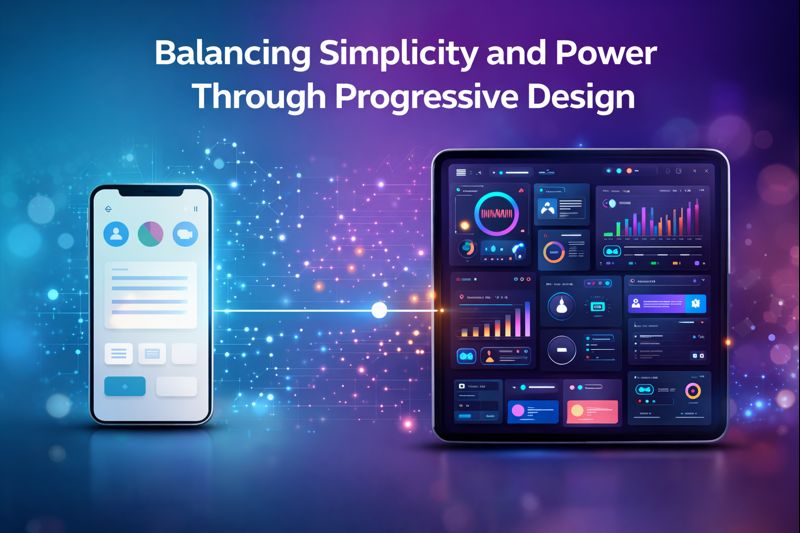
As a result, beginners perceive simplicity, while advanced users gain power over time.
UI and UX Design Impact on Retention and Revenue
Retention is the true success metric for SaaS applications. Strong UI and UX design reduces churn by making products easier to use and more difficult to replace.
Additionally:
- Fewer support tickets result in lower costs.
- Better usability boosts upsell adoption.
- Consistent experience builds brand trust.
Investing in UI and UX design has a direct impact on revenue growth.
Future of UI and UX Design in SaaS (2026 and Beyond)
Looking ahead, SaaS UI and UX design will focus on:
- Voice-based interactions
- Context-aware interfaces.
- Emotionally responsive design
- Cross-device continuity.
As SaaS products get smarter, design will serve as a link between human intent and machine intelligence.
Conclusion
The defining challenge of SaaS design is to strike the right balance between simplicity and power. Even the most advanced SaaS platforms fail to provide value unless they have SaaS products that become intuitive, scalable, and profitable when they are designed with a user-centric, data-driven, and future-ready mindset. In 2026, UI and UX design are no longer optional; they are fundamental.
Leave a Reply