Introduction
Apps break more frequently in today’s rapidly changing technological landscape because users expect speed, real-time performance, and complex features. Developers spend significant time fixing bugs, managing crashes, and troubleshooting performance issues. This slows innovation, raises costs, and causes uncertainty for businesses and research teams.
The rise of AI-powered systems, which detect errors automatically, repair code, and optimize performance without human intervention, has provided a strong solution. This new shift is transforming Mobile Application Development, particularly as we approach 2026-2030, when automation will be a core component of every digital system.
Why Mobile Apps Should Have Self-Healing Capabilities
Modern mobile applications run on a variety of devices, screen sizes, and network configurations. As a result, errors occur on a regular basis. Traditional debugging necessitates manual testing, multiple releases, and ongoing monitoring. As a result, teams face the following:
- Frequently crashes.
- High cost of maintenance.
- Slow release cycles.
- Bad user experience.
With billions of users relying on apps, even minor issues can have a big impact on overall performance.
How AI Addresses These Issues
AI now has capabilities for autonomous bug detection, AI error detection, automated code repair, and continuous mobile optimization. These technologies enable applications to recognize issues early, take action without waiting for developers, and adjust performance in real time. As a result, apps become more stable and secure, even when heavily loaded.
This shift is reshaping the future of mobile application development, driving startups, researchers, and engineering teams to intelligent mobile platforms.
Understanding AI-Powered Self-Healing Mobile Applications
Self-healing mobile apps detect, diagnose, and resolve software issues through automated intelligence. These systems operate continuously, learning from each interaction and creating new understanding. AI-Powered Self-Healing Mobile Applications include
- AI error detection for identifying unusual behavior
- AI automation tools for performing fixes
- AI-powered debugging and code-level repair
- Predictive app monitoring prevents future crashes.
- Mobile performance intelligence for continuous optimization.
As a result, applications become more dependable, scalable, and ready for the 2026-2030 digital ecosystem.
How AI Error Detection Works for Mobile Systems
AI error detection examines logs, user behavior, crash reports, CPU utilization, and app flow. Rather than waiting for a user to report a problem, AI instantly detects unusual patterns such as:
- Unexpected slowdowns
- Repetitive crashes
- Memory leakage
- unexpected network failure
It compares the data to historical patterns to predict where the next error will occur. This capability reduces the need for manual testing and helps both developers and AI automation engineers maintain large-scale apps.
The Role of AI Automation Tools in App Maintenance
AI automation tools are responsible for app repair and stabilization. These tools work in the background and handle:
- Repairing broken UI components
- Issues with patch logic
- Rewrite small sections of code.
- Making adjustments to API calls
- Recovering corrupted local data
Users face fewer disruptions because decisions are made instantly. This automation also increases the efficiency of mobile application developers, allowing them to focus on new features rather than constant debugging.
AI-Powered Mobile App Testing Automation
Testing is one of the most time-consuming phases of Mobile Application Development. Creating scripts for each screen, device type, and scenario is necessary in traditional testing. Artificial intelligence improves this process by:
- Generate test cases automatically.
- Finding missing scenarios
- Conducting device-specific performance tests
- Predicting Failure Points
- Understanding user patterns for more precise outcomes
Therefore, testing becomes more accurate and less dependent on manual scripts. This trend is becoming common among startups and research labs focused on next-generation mobile apps.
Automatic bug detection and automated code repair
As mobile application development has become more complex, developers require self-healing systems. Autonomous bug detection and automated code repair are essential in this scenario.
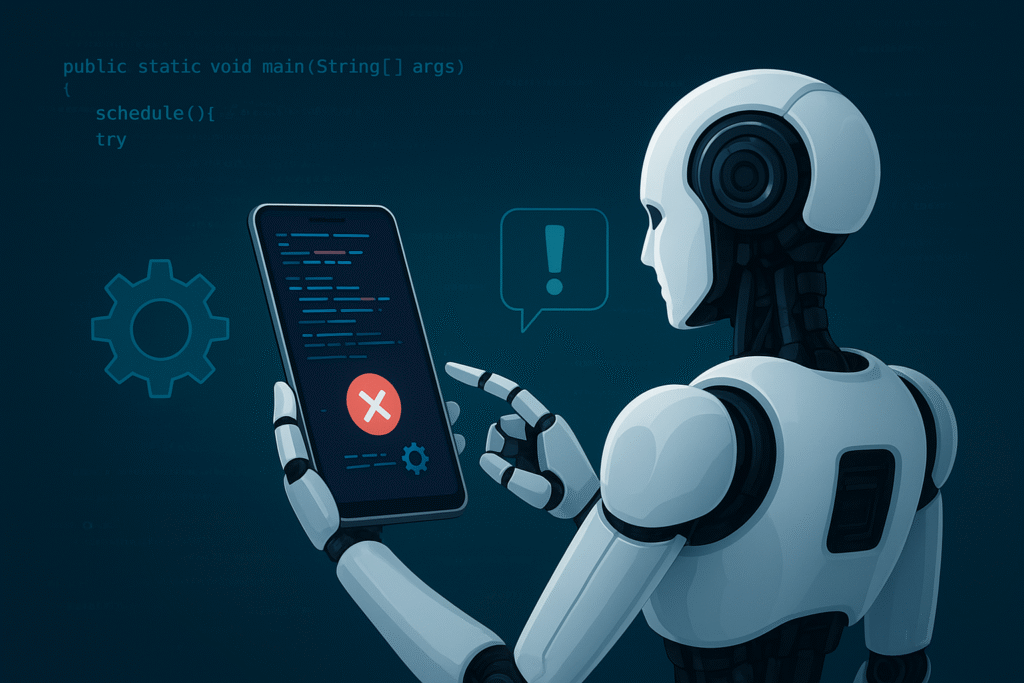
AI performs tasks like:
- Detecting Logic Failures
- Identifying unused or broken codes
- Rewrite unstable components.
- Making suggestions for optimized functions.
- Upgrading obsolete libraries
These automated repairs improve reliability, reduce maintenance time, and enable faster innovation.
Predictive App Monitoring in 2026 and Beyond.
By 2026, predictive app monitoring will be an essential component of every enterprise and startup. This enables systems to:
- Predict performance issues before they occur.
- Predict errors in user flows.
- Make recommendations for code optimization.
- Identify resource-heavy functions.
- Improve the overall health of the application.
Predictive systems ensure that mobile apps have zero downtime, which is critical for finance, healthcare, and large-scale service platforms.
Adaptive Mobile Architecture with Continuous Optimization
Self-healing mobile apps are built on architecture that adapts as the system grows. AI improves itself through continuous mobile optimization.
- CPU Utilization
- Memory Allocation
- API Responses
- Battery Efficiency
- Network Management
Furthermore, adaptive architecture ensures that the app runs smoothly on both high and low-end devices. This is especially important in areas with varying mobile hardware.
Future of Mobile Development: 2026-2030
Mobile development is shifting toward:
1. Fully automated maintenance: Apps will self-repair with little human assistance.
2. AI-First Development Process: Developers will use AI to write code, test modules, and improve performance.
3. Intelligent System Stability: AI will automatically scale resources, ensuring that apps remain stable even in high traffic conditions.
4. Systems for Continuous Learning: Each crash will teach AI how to improve the application in future releases.
This future will reduce human effort, boost innovation, and generate new jobs like AI automation engineer and intelligent systems architect.
Conclusion
AI-powered self-healing technology is transforming mobile app development. Mobile apps become more stable and scalable as AI error detection, automated repair, predictive monitoring, and continuous optimization are implemented. This trend is especially useful for researchers, scholars, and startups seeking high reliability and low maintenance costs. As we approach 2030, this technology will shape the next generation of mobile applications.
Leave a Reply