
Introduction
Modern AI workloads and 5G networks require real-time responses, continuous availability, and scalable infrastructures. However, many systems continue to rely on centralized cloud models, which suffer from latency, bandwidth constraints, and delayed decision-making.
To address this issue, organizations are now comparing edge computing and cloud computing as separate but interconnected computing models. When properly designed, enterprise-grade cloud engineering services allow startups, researchers, and enterprises to strike a balance between speed, scale, and intelligence while maintaining performance and compliance.
Understanding Edge Computing vs Cloud Computing
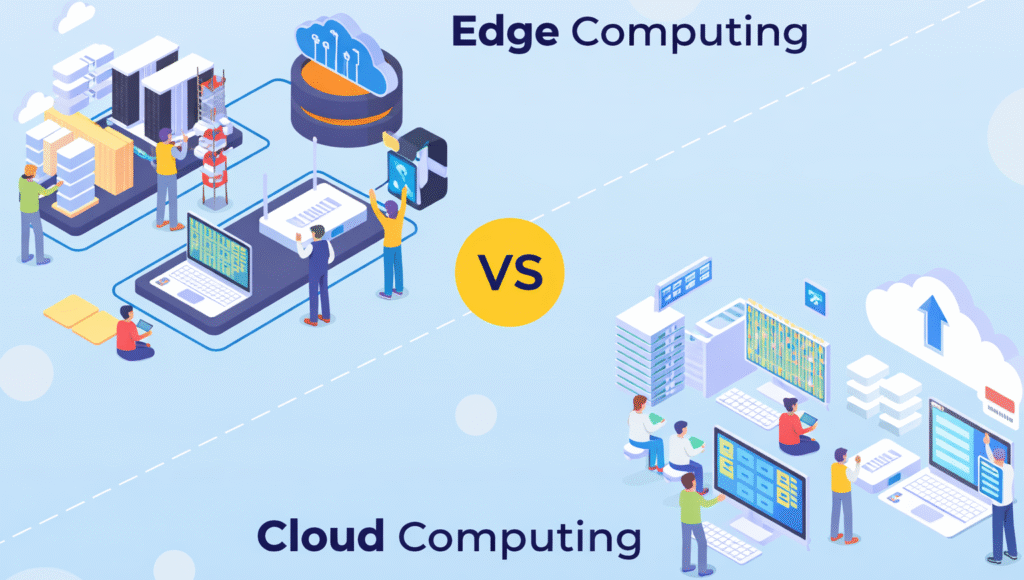
Before comparing use cases, it’s important to understand how both models work. Cloud computing is built on centralized data centers that are remotely controlled for networking, storage, and processing. Edge computing, on the other hand, works with data in proximity to its source, such as local edge servers, sensors, or devices.
As a result, cloud computing vs. edge computing cannot be a substitute for each other. Instead, it involves determining where computation should take place based on workload demands.
Role of 5G in Modern Computing Architectures
5G networks offer extremely low latency, high throughput, and widespread device connectivity. As a result, they facilitate real-time communication among machines, applications, and users. However, sending all 5G-generated data to a remote cloud computing server reduces the practical utility of 5G.
Cloud-based processing may not always satisfy real-time requirements due to physical distance. Edge computing closes this gap by processing time-sensitive data locally, whereas cloud platforms handle aggregation and intelligence. Thus, in 5G systems, edge computing vs cloud computing is a layered execution model rather than a single deployment option.
AI Workloads: Execution of Inference vs. Training
Depending on their purpose, AI workloads exhibit distinct behaviors.
Using Cloud Computing to Train AI
Cloud computing platforms are perfect for:
- Training models on a large scale
- GPU workloads with high performance
- Analytics of long-term data
- Centralized monitoring of experiments
Virtualization in cloud computing is crucial in this situation. Researchers and cloud computing engineers can scale compute resources dynamically thanks to virtualized environments.
Edge Computing for AI Inference.
On the other hand, AI inference needs:
- Immediate decision-making
- Continuous availability.
- Low-latency responses
Edge computing enables inference to run close to devices, allowing for real-time systems such as autonomous machines and monitoring platforms. Therefore, the distinction between edge computing and cloud computing for AI workloads is functional rather than competitive.
Latency and reliability considerations
Latency directly affects system reliability. When data travels over long distances to a cloud computing server, delays occur due to network congestion and routing paths.
Edge computing reduces this delay by executing logic close to the data source. As a result, systems become more resilient even when the network is unstable.
Latency is the most important technical factor influencing edge computing vs cloud computing decisions in architectures ready for 2026.
Data Governance and Security in Distributed Systems
Security requirements are becoming stricter due to global data regulations. Cloud platforms offer strong centralized security controls, identity management, and audit capabilities.
However, continuous data transmission increases the possibility of exposure. Edge computing reduces the risk by storing sensitive data locally. However, managing security across distributed nodes necessitates automated governance frameworks.
Therefore, the security of edge computing vs cloud computing depends on centralized policy enforcement with distributed execution, often managed through cloud-based orchestration layers.
Benefits of Cloud Computing
Despite edge growth, the benefits of cloud computing remain critical.
Key advantages include
- Scalability can be elastic.
- Global accessibility.
- Strong ecosystem support
Cloud computing providers offer advanced services for analytics, AI pipelines, DevOps, and collaboration. For startups and scholars, this reduces infrastructure barriers and accelerates experimentation. Because of these benefits, cloud platforms remain essential even in edge-first architectures.
Edge and Cloud Deployment Models for 2026
Modern systems no longer use a single deployment model. Instead, they use hybrid architectures to distribute workload strategically.
Hybrid execution methodology.
- Edge nodes perform real-time AI inference.
- Cloud systems manage training, analytics, and storage.
- 5G networks connect edge locations efficiently.
This design reflects how edge computing and cloud computing function in real-world production environments, particularly for research platforms and emerging startups.
Role of Cloud Computing Engineers
The role of a cloud computing engineer is evolving, as are the architectures. Now, engineers must comprehend:
- Models of distributed execution
- Orchestration on the edge
- Cloud computing virtualization
- Automation of security in various environments
Designing scalable AI and 5G systems increasingly requires this combination of skills.
Use Cases Across Industries
Edge Computing Use Cases
- Autonomous vehicles
- Industrial automation
- Smart traffic systems
- Real-time healthcare monitoring
Cloud Computing Use Cases
- AI model development
- Research data aggregation
- Software development and testing
- Enterprise analytics platforms
In practice, edge computing vs cloud computing becomes a workload placement strategy, not a technology choice.
Cloud Computing Consulting
Many startups lack the internal expertise to design distributed architectures. Cloud computing consulting assists organizations:
- Choose the correct workload placement.
- Optimize infrastructure cost
- Implement security and compliance
- Scale AI and 5G systems efficiently.
Consulting allows researchers to ensure that their systems are reproducible, scalable, and cost-effective.
Will Edge Computing Replace Cloud Computing?
Cloud computing will not be replaced by edge computing. Instead, it increases cloud capabilities to meet demands instantly.
The cloud remains the backbone for:
- Centralized governance.
- Data Aggregation
- Advanced analytics
- Long-Term Intelligence
Therefore, edge computing vs cloud computing work together to develop a cooperative model that leads to distributed intelligence.
Conclusion
Modern AI and 5G systems require both speed and scalability. Edge computing enables local responsiveness, whereas cloud computing provides centralized intelligence and flexibility.
Understanding edge computing vs cloud computing enables startups, researchers, and enterprises to design systems that are dependable, secure, and future-proof. The success of digital platforms in 2026 will be determined by the effective distribution of intelligence across edge and cloud layers.
Leave a Reply