Category: Custom Software Development

  • Hardest Programming Language for Developers: Myth vs Real-World Challenges

    Hardest Programming Language for Developers: Myth vs Real-World Challenges

    Introduction

    Many developers look for the hardest programming language, as modern software development appears to be more challenging than ever. With the rise of cloud platforms, AI-powered systems, and distributed applications, even experienced engineers are encountering challenges that did not exist a few years ago.

    The problem is that most discussions oversimplify the difficulty. In 2026, programming language difficulty will no longer be measured by syntax or learning speed. It is about how well a language enables developers to handle modern system responsibilities while minimizing critical risks.
    hardest programming language

    Difficulty Does Vary, But Only to a Point

    It is widely acknowledged in both industry and academic circles that programming difficulty varies from developer to developer. The complexity of a language is influenced by its background, experience, and problem domain. However, this explanation is no longer enough.

    Even highly skilled developers in modern production environments struggle with specific languages due to external system pressures. This isn’t a matter of opinion; it has been observed repeatedly in large-scale engineering teams.

    Why Programming Languages Are Becoming Harder in 2026

    In 2026, software systems should be able to operate continuously, scale automatically, and remain secure in unpredictable conditions. These expectations have a direct impact on program complexity.

    Language difficulty increases when developers must manage

    • Cloud-native environment execution.
    • AI and Data-Driven Behavior
    • Failures occur in distributed systems.
    • Security and performance guarantees

    Languages that expose these responsibilities directly to developers are often described as the hardest programming languages to learn, not because they are poorly designed, but because they demand deeper system-level thinking.


    Cloud-Native Systems Increase Cognitive Load

    Modern applications are no longer deployed as separate units. They are divided into microservices, deployed in multiple regions, and scaled dynamically.

    Languages such as C++ and Rust have significant difficulties in such environments. Developers must focus on memory, concurrency, and failure handling, as well as cloud behaviors such as autoscaling and container orchestration.

    Industry engineering blogs and cloud incident reports frequently highlight how minor low-level errors in these languages can cause large-scale system failures. This is why they are often referred to as the most challenging programming language options for cloud-native systems.

    AI Integration Changes the Nature of Difficulty

    Artificial intelligence systems introduce nondeterministic behavior. In contrast to fixed logic, outputs are determined by data, models, and runtime conditions.

    In AI-heavy architectures, languages that require strict memory and execution control become more difficult to use safely. Developers using Rust or C++ in AI inference pipelines must simultaneously manage parallel workloads, latency constraints, and memory safety.

    This is a well-documented issue in industry discussions about AI infrastructure. As a result, these languages are frequently referred to as the most difficult coding language options available in AI-centric systems.

    Distributed Systems Make Errors Harder to Trace

    In distributed systems, failures can be expected. Network partitioning occurs, services fail, and data becomes temporarily inconsistent.

    Languages with low-level control but few abstractions force developers to handle these scenarios manually. Debugging such issues across multiple services is one of the most frequently mentioned pain points in real-world engineering postmortem reports.

    This is the main reason why Assembly, C++, and Rust are consistently mentioned when discussing the hardest programming languages to learn for large-scale distributed systems.

    Security-by-Design Raises the Stakes

    Security is no longer a choice. Systems must be secure by default in 2026.

    Languages that allow unsafe memory operations impose greater responsibility on developers. A single mistake can expose serious vulnerabilities. According to industry security analyses, memory-related bugs remain one of the most costly types of software errors.

    Because of this, developers often ask, What is the hardest computer language to learn for secure system design?. Typically, the response indicates languages in which developers are responsible for enforcing security.

    So Which Programming Languages Will Actually Be the Hardest in 2026?

    The following languages are consistently demonstrated as the most challenging in real-world situations based on engineering experience, industry usage, and system requirements.

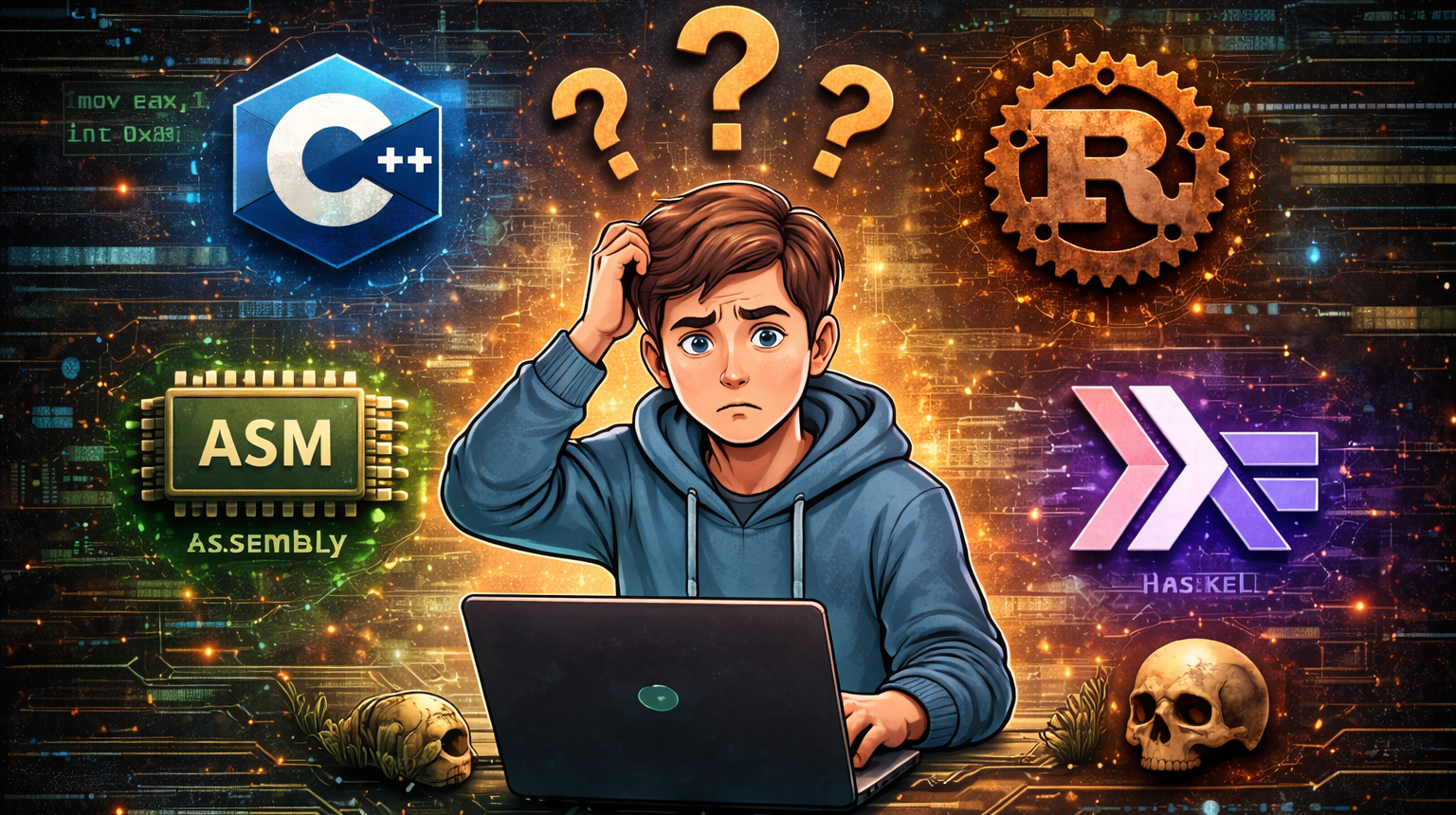
    C++

    C++ remains one of the most difficult programming languages due to its combination of performance requirements, manual memory management, and rising security expectations. In cloud and AI systems, the error margin is very minimal.

    Rust

    Rust is safer by design, but its ownership and lifetime models significantly raise the learning curve. Multiple industry surveys confirm that Rust reduces bugs but necessitates longer onboarding. This makes it the hardest programming language to learn for many developers new to modern systems programming.

    Assembly Language

    Assembly continues to be the toughest coding language because it offers no abstraction. In 2026, it is used only where absolute hardware control is required, making it extremely difficult to maintain and scale.

    Haskell (in Modern Architectures)

    Haskell becomes difficult to integrate into cloud and AI ecosystems. The challenge is not syntax but rather architectural integration and mental models. This ranks it among the hardest programming languages to learn in modern production environments.

    Myth vs Reality

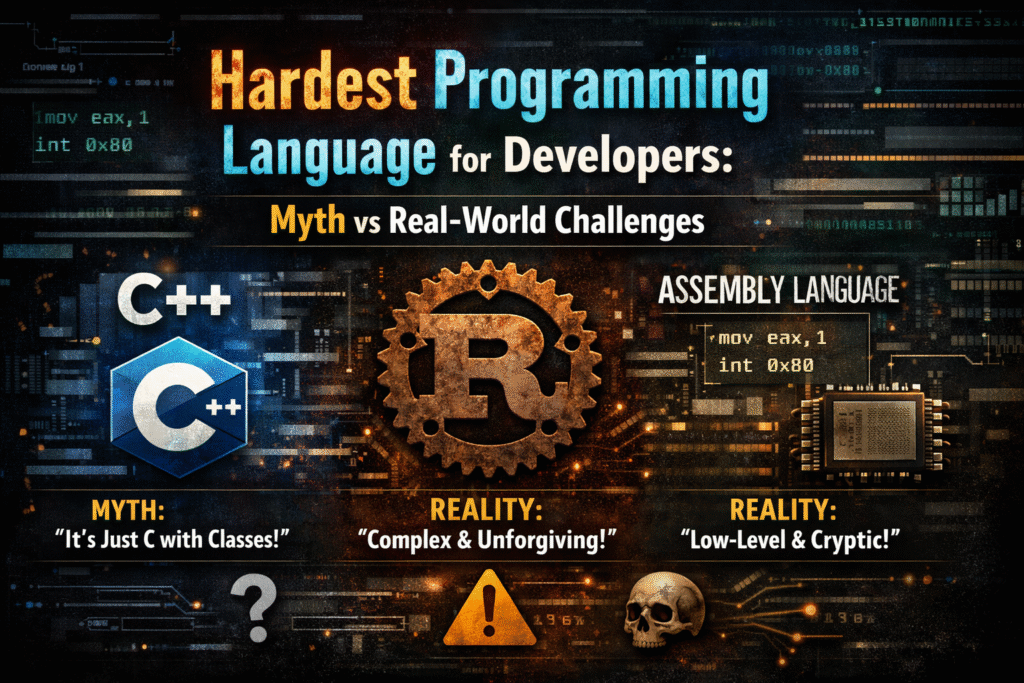
    According to the myth, the hardest coding language is inherently complex. In reality, languages become challenging when modern systems assign more responsibility to developers. A language earns the title of “toughest programming language” when it forces developers to simultaneously manage infrastructure behavior, AI logic, security risks, and performance constraints.

    Final Conclusion

    So, what is the hardest programming language in 2026?

    There is no single, universal answer. However, C++, Rust, Assembly, and Haskell consistently stand out as the most difficult to manage under modern demands such as AI integration, cloud-native execution, distributed reliability, and security-by-design.

    That is not a theoretical difficulty. It is monitored, documented, and experienced by developers throughout the industry.


  • Ecosystems in Modern Web Application Development:              The Next Wave of Autonomous Architectures and AI-Native Engineering 2026

    Ecosystems in Modern Web Application Development: The Next Wave of Autonomous Architectures and AI-Native Engineering 2026

    Introduction

    The world of web application development is approaching a tipping point. Businesses struggle to meet the scale and unpredictable nature of modern digital demands as system complexity increases and user expectations rise. Long iteration cycles pose challenges for startups, while enterprise systems have reliability gaps. Researchers struggle to create applications that respond dynamically to changing user behaviors.

    The rise of intelligent ecosystems, or web applications that learn, adapt, and optimize themselves, holds the key to addressing these issues. These ecosystems, which are powered by cognitive automation, LLM apps, autonomous systems, and AI-native engineering, are more than just software; they represent a shift toward living, evolving digital systems that do not require constant human intervention.

    Intelligent-Web-application-development

    These intelligent ecosystems will not only change the way of web application development, but also how they evolve. Let’s look at the key components of intelligent ecosystems and why they represent the future of web development.

    1. Intelligent Ecosystems: The New DNA of Web Application Development

    Traditional web applications will be phased out in favor of intelligent ecosystems that can think, learn, and adapt in real time. These ecosystems will not have rigid workflows or static logic; instead, they will operate as dynamic networks that evolve over time.

    Key Features of Intelligent Ecosystems:

    • Predict user intentions and respond accordingly.
    • Automation AI is capable of re-wiring workflows autonomously.
    • Learn from operational and behavioral data to enhance the user experience.
    • They automatically update themselves without the need for developer intervention.

    This new approach alters the lifecycle of a web application. Instead of the traditional process of development, deployment, and monitoring, the flow is now:

    Observe → Learn → Adapt → Optimize → Evolve

    Why This Matters in 2026:

    • Reduced operational overhead by 40-70%.
    • 4x faster adaptation to changing business needs.
    • Using real-time signals, users can predict their experiences.
    • Applications that update themselves without user approval.

    These aren’t just theoretical concepts; they’re quickly becoming the competitive benchmark for businesses looking to stay ahead.

    2. Cognitive Automation: The Heart of Intelligent Web Apps.

    Traditional web apps rely on user-defined triggers and monitoring, which frequently fail when traffic or system conditions differ from expectations. Cognitive automation transforms web applications into self-learning entities capable of predicting and adjusting in real time.

    Cognative-automation-AI

    How Cognitive Automation Enhances Applications:

    • Predictive UX Adjustments: Rather than relying on static personalization rules, cognitive systems predict user intent, emotional state, and friction points and adjust the UI and logic accordingly.
    • Self-optimizing Workflows: Workflow Automation AI enables applications to automatically reroute processes based on network health, resource load, and cost predictions, all without the need for engineer intervention.
    • Real-Time Risk Prevention: Cognitive systems can detect anomalies and inefficiencies before they cause failures, resulting in higher uptime and more reliable operations.

    Why Does It Matter:

    • Fewer failures and faster decision-making.
    • Evolving user experiences that respond to users’ needs and behaviors.
    • A smooth transition to post-2026 digital expectations.

    3. Autonomous Architectures: Making Software Live and Breathe.

    Autonomous systems go beyond conventional automation. They create web applications that can heal, scale, protect, and configure themselves.

    Key Features of Autonomous Systems:

    • Self-healing: Failures are automatically isolated and repaired without manual intervention.
    • Predictive Scaling: Uses behavioral data and predictive analytics to scale system resources before traffic spikes occur.
    • Zero-Downtime Updates: LLM-powered compilers can change code and workflows without redeploying the application.
    • Autonomous Security: Identifies and patches vulnerabilities automatically, ensuring security without human intervention.

    The results 2026:

    • 90% reduction in unplanned downtime.
    • 3-5 times faster global scaling.
    • Reduced vulnerability to DDoS attacks and zero-day exploits.

    With these features, autonomous architecture will become a necessary component of any application, rather than a desirable feature.

    4. AI-Native Software Engineering: Rewriting the Development Playbook.

    By 2027, LLM apps (Large Language Models) will no longer be considered optional development tools. They will become key contributors to the development process, fundamentally changing the way we build software.

    How LLM Apps Redesign Development:

    • Autonomous Code Evolution: LLMs will be able to refactor and rewrite their own code, resulting in faster and more error-free development.
    • Predictive testing: This will be driven by predictive models that take into account previous failures, regression risk, and new logic.
    • Intelligent CI/CD: Models that predict stability and reduce deployment risks will be used to improve continuous integration and deployment.

    Impact:

    • Faster release cycles for startups.
    • Fewer errors and greater reliability for enterprises.
    • Unprecedented experimentation capabilities for researchers.

    5. Edge and Serverless: The Backbone of Intelligent Ecosystems

    To function optimally, intelligent ecosystems require a strong and distributed infrastructure. Edge computing and serverless architectures are critical to achieving real-time, low-latency execution and scalability.

    Why Edge + Serverless is a Must?

    • Extremely low latency for applications that run in real time.
    • Cost-effectiveness in serverless environments because of per-trigger execution.
    • High availability is ensured by automatic failover throughout multi-region grids.
    • While maintaining privacy, processing data closer to the user enables real-time personalization.

    Significant Progress for 2026:

    • Edge Intelligence: By operating at the edge, nearer to users, machine learning models lower latency and boost efficiency.
    • Adaptive serverless functions: Optimize resource usage by self-adjusting.
    • Decentralized API Fabric: APIs that automatically route to the closest or least expensive node, increasing productivity and economy.

    This infrastructure allows applications to operate as intelligent ecosystems rather than traditional, centralized systems.


    6. The Role of AI Chatbots and Agents in Intelligent Ecosystems

    In an intelligent ecosystem, AI chatbots and agents are no longer just a UI feature; they serve as the cognitive engine driving the system’s intelligence.

    AI-chatbot-in-web-application-development

    How AI Chatbots and Agents Can Improve Ecosystem Intelligence:

    • Continuous Dialogue Operations: Developers can use natural language commands to control systems, replacing traditional dashboards with conversational interfaces.
    • Autonomous Knowledge Retrieval: AI agents can interpret logs, predict incidents, and provide proactive solutions.
    • Multimodal Execution: Agents will run workflows, initiate deployments, and tune performance independently.

    These AI-powered agents will be at the core of intelligent ecosystems, integrating engineering, operations, and product development into a unified system.

    Conclusion

    The future of web application development isn’t just about improving frameworks and tools; it’s about building intelligent ecosystems that evolve, optimize, and adapt themselves. With the integration of cognitive automation, autonomous systems, and AI-native engineering, future web applications will behave like living digital organisms, constantly learning, repairing themselves, anticipating user needs, and executing tasks autonomously.

    Organizations that start building these ecosystems now will not only thrive in 2026 but will also drive the next wave of digital transformation and innovation.

  • How to Choose the Right Custom Software Development Company in 2026

    How to Choose the Right Custom Software Development Company in 2026

    Introduction

    In 2026, technology will change faster than ever. Companies need development partners who can keep up with new trends, use modern features such as AI, and build future software that remains relevant for years. But with so many options in the market, it becomes challenging to identify which partner truly provides long-term value and reliable solutions

    A strong custom software development company provides clear guidance, modern technical expertise, and long-term support.The right partner not only builds software but also understands your business goals, reduces risks, ensures scalability, and helps your product to grow confidently in 2026 and beyond.  

    Custom software development checklist 2026

    What Does Custom Software Development Really Mean in 2026?

    Custom software development in 2026 means building digital solutions that are fully customized to your business, not generic, not one-size-fits-all. Moreover, it’s about creating secure, scalable, AI-ready systems that match your unique workflows, customer needs, and long-term goals.

    It includes:

    • Requirements gathering
    • UI/UX design
    • Development
    • Testing
    • Deployment
    • Ongoing support and optimization

     Businesses use customized software to increase productivity. Additionally, automate manual tasks, improve customer experiences, and gain a competitive edge.

    Here is a simple 6-point checklist to help you select the right custom software development company to prepare for your business growth.

    1. Understanding the business goals 

    Before reaching out to any company, make sure you know exactly what you want. Defining your goals upfront protects time, effort, and money going forward. 

    What to Define: 

    • Type of Software: Mobile, web app, or both? 
    • Phase of Project: Are we starting a brand-new application or improving an existing one? 
    • Budget & Timeline: Set general timelines for building and future support. 
    • Business Problem (The “Why”): What issue is this software going to solve? i.e., decrease manual reporting time by 50%.

    2. Validate Industry Proficiency and Business Connection 

    You need more than just technical skills. They should have a strong understanding of your industry and business objectives. 

    Look for:

    • Industry Experience: Check if the company has worked in your field before (like FinTech, HealthTech, Logistics, etc.). When they already understand your industry, communication becomes easier and the work gets done faster.
    • Well-Structured Discovery Phase: A good company starts with a discovery phase (a paid step) where they clearly explain what work will be done and what technology will be used. This saves you from costly mistakes and big changes later.
    • Business Context: Can they take high-level business goals and turn them into software requirements that solve real-world problems? 

    Having a good partner like this means more than just having someone to write code. Good partners advise and help you through the process. 

    3. Insist on a Modern and Secure Tech Stack 

    Your software should be developed in a way that supports scalability, security, and future improvements without issues. 

    Look for: 

    • Cloud-Native Skillsets: Look for expertise in AWS, Google Cloud, or Azure, as these skills can scale your app quickly. Cloud-based apps are generally more reliable and easier to support. 
    • AI/Machine Learning: Ask them to provide examples of how they add AI, automation, or predictive analytics. As a result, this will help you to understand how they can bring modern features to your app.
    • Modern Frameworks: Familiarity with frameworks like React, Node.js, Python/Django, Kotlin, and Swift. Avoid legacy systems that cause problems later. 
    • Security & Compliance: Security should be built into the code (security by design), and development should be framed using security and compliance standards such as GDPR, HIPAA, SOC 2, etc., as necessary. 

    4. Review Their Transparent Development Process

    An open process collects regular updates,which in turn reduces mistakes and provides speedy feedback.

    Key Elements:

    • Agile + DevOps: Confirm Scrum/Kanban methodologies and CI/CD pipelines. Minor, functional updates should come at least every 1-2 weeks.
    • Live Tracking: Ensure you can access project tools (e.g., Jira, Trello, or GitHub/GitLab) to check project status.
    • Dedicated QA Team: Testing should be managed by a team of QAs that has both automated and manual tests.
    • Code Ownership: You should have 100% ownership of the source code and obtain complete current documentation.

    5. Consider team perspective, communication, and UX/UI.

    The best software is easy to use and built by a team that communicates well during the project development.

    • UX/UI Capabilities: Look at their wireframes, prototypes, or previous projects. Software should be responsive across all devices.
    • You Speak to Developers Directly: You need to be dealing with developers, not only project managers, for better technical understanding.
    • Communication and Time Zone Fit: They should be able to explain technical topics simply and have enough time zone communication for meetings
    Business team custom software development company

    6. Evaluate Total Cost of Ownership (TCO)

    Don’t go with the cheapest company; focus on long-term value as well as stability.

    Elements to Consider:

    Pricing Model: Time & Material (T&M) is ideal for flexible, evolving projects, while fixed-price works best for small, well-defined projects.

    • TCO: Total cost of ownership: hosting, licenses, maintenance, and future updates. 
    • Post-launch support: Warranty and bug fixes, and future maintenance.
    Salary Comparison
    (US Average) 
    Role 
    Full-Stack Developer $102,000 
    DevOps Engineer $120,000
    Data Scientist $120000
    Total Annual Costs $341,000+

    Partnering with a custom software development company lets you access expert skills faster and at a lower cost than building an in-house team.

    Select a Partner for Growth

    Custom software will be essential for growth in 2026. Use this checklist to pick the best development company’s services that align with your goals and expertise.

    The Right Custom Software Development Company

    • understands your business goals
    • uses modern, secure technology
    • provides a transparent development process
    • communicates clearly and collaborates well
    • supports your application software long after launch

    Choose wisely. The best partner will help you ensure your software delivers real business value and supports your growth long-term.