
Introduction
Mobile applications are no longer considered standalone products. In large-scale smart cities and IoT-driven environments, mobile apps serve as operational interfaces for distributed systems, cloud platforms, and real-time data pipelines. In this context, technology decisions are made based on long-term system behavior, scalability, and organizational efficiency rather than features or frameworks.
React Native development services are increasingly being integrated into enterprise mobile strategies, not as a shortcut, but as an architectural choice. Organizations deploying IoT-connected platforms use React Native to integrate mobile delivery with modern backend, DevOps, and data-driven ecosystems.
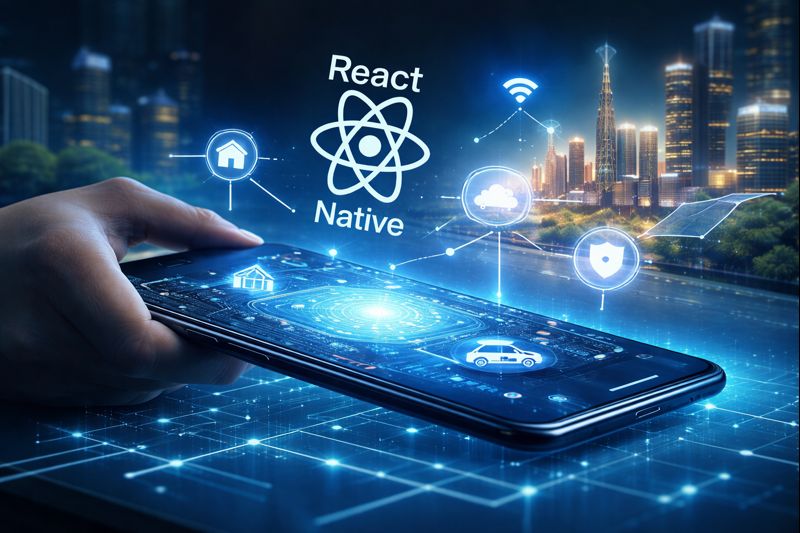
React Native’s Shift from Framework to Strategic Layer
At the industrial level, React Native is no longer considered a “cross-platform tool.” It is viewed as a presentation and interaction layer that sits atop complex infrastructures like IoT networks, edge devices, cloud services, and analytics engines.
Companies are separating concerns more aggressively than before. Business logic, data processing, and device communication occur outside of the mobile app, whereas React Native applications focus on orchestration, visualization, and user interaction. This separation enables mobile systems to evolve without disrupting the core infrastructure.
This architectural role is one of the primary reasons why React Native app development services are being used in long-term smart city initiatives rather than short-term pilots.
Enterprise Mobile Architecture in IoT-Connected Environments
Mobile applications rarely interact directly with IoT devices. Instead, they use APIs, event streams, and control layers to aggregate sensor data and system state. React Native fits naturally into this model because it is designed to be API-first.
Modern mobile architectures are increasingly based on:
- Data flows triggered by an event
- Communication is asynchronous.
- Real-time state synchronization.
React Native supports these patterns without requiring teams to keep separate Android and iOS implementations. This reduces fragmentation and keeps mobile interfaces in sync with backend evolution.
This alignment is critical in smart city environments because infrastructure systems are constantly changing.
Organizational Impact on Engineering Teams
One of the most significant React Native-driven changes is organizational rather than technical. Enterprises using React Native are reshaping the way mobile teams operate.
Instead of maintaining separate Android and iOS teams, businesses are transitioning to unified mobile engineering groups that share code, tooling, and release cycles. This reduces internal friction and enhances cross-functional collaboration between the backend and frontend teams.
This shift has a direct impact on the following business aspects:
- Time-to-market
- Engineering Cost Predictability
- Knowledge retention.
- Long-term maintenance planning.
This is a major reason why businesses continue to hire React Native developers even when native expertise is already available in-house.
React Native in Real-Time Operational Systems
Smart city platforms are based on real-time awareness. Traffic management, energy monitoring, public services, and infrastructure control systems necessitate mobile interfaces that can respond quickly to system changes.
React Native applications are increasingly being used as operational dashboards, rather than consumer-facing apps. These dashboards collect live data, display system status, and initiate actions across multiple distributed systems.
In such use cases, performance is measured not in animations or user interface polish, but in
- Data Freshness
- Interaction responsiveness
- Stability under continuous updates
Experienced React Native developers focus on managing state, rendering efficiency, and background processing to meet these operational demands.
Integration with Cloud, Edge, and AI Systems
By 2026, cloud-native architectures and edge computing will be thoroughly integrated into smart city platforms. Instead of acting as separate logic containers, mobile applications function as clients of these systems.

React Native works well with:
- Web-based APIs
- Edge processing nodes
- AI-powered analytics systems
This enables mobile apps to be lightweight while also supporting advanced features like predictive alerts, anomaly detection, and automated decision workflows.
The role of React Native is not to process intelligence but to present intelligence in a usable and reliable format.
Why Enterprises Choose React Native Over Fully Native Stacks
At the scale, technology decisions are influenced by consistency and sustainability, rather than theoretical performance differences. Enterprises that use React Native development services prioritize operational stability over marginal gains.
Fully native stacks add long-term complexity:
- Duplicate feature development.
- Parallel Quality Assurance processes
- Fragmented release pipelines.
React Native reduces duplication while retaining native module support where hardware-level access is required. This hybrid approach gives enterprises control without imposing rigidity.
For smart city and IoT-connected systems, this balance is frequently more important than platform-specific optimizations.
Role of React Native Development Companies in Large Programs
Large-scale initiatives frequently include multiple stakeholders, regulatory requirements, and lengthy delivery timelines. Partnering with a React Native development company gives you access to structured delivery models and accumulated expertise.
These companies have experience in:
- Managing big codebases
- Coordinating multiple release roadmaps.
- Ensure security and compliance.
- Supporting long-term maintenance.
For governments and businesses, this lowers execution risk and improves project continuity across phases.
Native Capabilities Within React Native Systems
Although React Native focuses on shared code, industrial systems still require direct access to device capabilities like sensors, location services, and secure storage. React Native facilitates this through native modules that seamlessly integrate with platform-specific code.
This enables teams to maintain native mobile app development capabilities while preserving cross-platform efficiency. In IoT environments, this is critical for interacting with hardware-level features while keeping the application architecture consistent.
React Native as an Interface for Infrastructure, Not Users
The audience shift has been one of the most significant changes in how React Native is used today. Many React Native apps in smart city settings are not consumer products. They include internal tools, control interfaces, and monitoring systems.
These apps prioritize:
- Reliability trumps aesthetics
- Data clarity over engagement
- Prioritize operational accuracy over personalization.
This shift is supported by React Native, which allows for rapid iteration while remaining stable in the face of constant system updates.
Long-Term Maintainability and System Evolution
Smart city platforms are designed to evolve over decades, not years. Mobile interfaces must adapt as infrastructure expands, regulations change, and new technologies emerge.
The modular architecture of React Native enables teams to add new features, replace backend systems, or integrate additional services without having to rebuild the entire mobile layer. This makes React Native development service models ideal for long-term public and enterprise deployments.
Maintenance becomes a managed process rather than a recurring crisis.
React Native’s Position in the 2026 Technology Landscape
By 2026, React Native will no longer compete with native development in terms of ideology. It competes for system compatibility, team efficiency, and architectural alignment.
Enterprises choose React Native not because it is “easier,” but because it fits into modern software ecosystems based on APIs, cloud services, and continuous delivery.
This positioning establishes React Native as a reliable option for organizations investing in connected, data-driven platforms.
Strategic Value for Business and Governance
For decision-makers, the value of React Native lies in predictability. Projects that use unified mobile architectures are easier to budget, manage, and scale.
Governments and businesses that implement smart city systems benefit from
- Consistent user interface
- Quicker response to system changes.
- Reduced reliance on platform-specific teams.
These factors have a direct impact on the success of long-term digital initiatives.
Conclusion
React Native has grown from a development framework to a key component of enterprise mobile architecture. It serves as a stable interface layer in smart cities and IoT-connected environments, connecting complex systems to human operators.
Organizations that use React Native development services benefit from architectural consistency, operational efficiency, and long-term flexibility. As smart systems grow in size and complexity, React Native’s role as an enterprise-ready mobile solution will become increasingly important.