Author: waqas@solutionsloft.com

  • AI Chatbot Development Services: Building Smarter Digital Conversations for 2026

    AI Chatbot Development Services: Building Smarter Digital Conversations for 2026

    Introduction

    Businesses today face a common issue: customers expect instant responses, personalized support, and 24-hour availability. Traditional customer support systems struggle to meet these expectations on a large scale.

    AI chatbot development services address this issue by enabling intelligent, automated, and human-like interactions across websites, apps, and enterprise platforms, allowing businesses to reduce costs while improving customer experience.
    AI chatbot development services

    What Are AI Chatbot Development Services?

    AI chatbot development services include designing, building, deploying, and maintaining intelligent chatbots that interact with users in natural language. These chatbots understand intent, context, and behavior in addition to providing scripted responses.

    Modern AI chatbot development service providers employ machine learning, natural language processing (NLP), and large language models to create chatbots that learn and improve over time. Chatbots will be core digital assets by 2026, rather than optional tools.

    These services are used in customer service, sales, human resources, healthcare, finance, education, and internal operations.

    Why Businesses Need AI Chatbot Development Services in 2026

    Customer behavior has shifted. Users want quick responses, accurate information, and seamless digital interactions. Businesses that rely solely on human agents experience delays, increased costs, and inconsistent responses.

    Businesses can scale conversations using AI chatbot development services without expanding their support teams. Chatbots work continuously, respond instantly, and adhere to consistent communication standards.

    Key advantages include faster response times, lower operational costs, higher customer satisfaction, and better data insights.

    Core Capabilities of Modern AI Chatbot Development Services

    Today’s AI chatbot development services prioritize intelligent, adaptable, and secure solutions. These chatbots are intended to handle complex conversations rather than simple questions.

    They recognize intent rather than keywords, keep conversation histories, and integrate with business systems such as CRMs and ERPs. This enables chatbots to provide meaningful responses rather than generic replies.

    As AI advances, chatbots become more proactive, predictive, and decision-aware.

    Custom AI Chatbot Development Services for Business-Specific Needs

    Every company operates differently. That is why custom AI chatbot development services are necessary. Prebuilt chatbots cannot handle custom workflows, industry regulations, or brand voice.

    Custom development enables businesses to train chatbots using proprietary data, business rules, and actual customer interactions. This guarantees accuracy, relevance, and compliance.

    Custom AI chatbot development services give businesses complete control over chatbot behavior, integrations, and future scalability.

    AI Chatbot App Development Services for Mobile-First Users

    Mobile use continues to dominate digital interactions. AI chatbot app development services are focused on integrating intelligent chatbots directly into mobile applications.

    Users can use these chatbots for onboarding, feature guidance, order tracking, notifications, and app support. They reduce friction and increase retention.

    In 2026, AI chatbot app development services will prioritize offline functionality, voice support, multilingual capabilities, and personalized user flows.

    AI Chatbot Development Service for Websites

    Many customers continue to use websites as their first point of contact. An AI chatbot development service for websites allows for instant engagement with visitors.

    Website chatbots can answer product questions, qualify leads, schedule demos, and direct users through complex pages. Unlike traditional live chat, AI chatbots can scale without relying on humans.

    Businesses that use an AI chatbot development service for their websites typically experience higher conversion rates and lower bounce rates.

    Enterprise AI Chatbot Development Service for Large Organizations

    Large organizations require advanced, secure, and scalable chatbot systems. An enterprise AI chatbot development service specializes in managing high traffic, multiple departments, and complex workflows.

    Enterprise chatbots work with internal systems such as HR platforms, knowledge bases, and ticketing tools. They also adhere to strict data security and compliance standards.

    Organizations use enterprise AI chatbot development services to automate internal operations while maintaining control and governance.

    Role of AI-Powered Chatbots Development Services in Automation

    AI-powered chatbot development services play an important role in business automation. These chatbots automate repetitive tasks, reducing manual workloads.

    They can process requests, retrieve data, update records, and initiate workflows without requiring human intervention. This increases efficiency and minimizes errors.

    As automation evolves in 2026, it will act as an intelligent assistant rather than a simple responder.

    Technologies Behind AI Chatbot Development Services

    Modern AI chatbot development services are built using advanced yet practical technologies. These systems focus on accuracy, scalability, and continuous learning.

    Common technologies include natural language processing engines, transformer-based language models, intent classification systems, and sentiment analysis. Integration layers connect chatbots to business tools.

    Security, data privacy, and ethical AI usage are all important technical considerations in 2026.

    Industry Use Cases of AI Chatbot Development Services

    Different industries use AI chatbot development services in different ways, depending on their needs.

    Customer support teams use chatbots for issue resolution and ticket handling. Sales teams use them for lead qualification and follow-ups. HR teams use them for employee queries and onboarding.

    Healthcare, finance, and education sectors also rely on chatbots for secure and guided interactions.

    How AI Chatbot Development Services Improve Customer Experience

    Speed, accuracy, and personalization are all critical components of the customer experience. AI chatbot development services benefit all three areas.

    Chatbots respond instantly and remember user preferences. They shorten wait times and eliminate repetitive questions.

    By analyzing user behavior, chatbots offer relevant suggestions and proactive assistance, making interactions smoother and more useful.

    Scalability and Performance in AI Chatbot Development Services

    Scalability is critical for chatbot success. AI chatbot development services are designed to handle increased traffic without sacrificing performance.

    Cloud-based architectures enable chatbots to automatically scale during peak usage. Load balancing and monitoring ensure stability.This makes chatbots appropriate for both startups and large enterprises.

    Security and Compliance in AI Chatbot Development Services

    Data security is an important consideration in digital interactions. Strong encryption, access control, and secure data handling are all part of reliable AI chatbot development services.

    Compliance with regulations, such as data privacy laws, is critical, particularly for enterprise solutions. Chatbots must handle data responsibly and transparently.

    By 2026, ethical AI practices will be expected as standard.

    Future Trends Shaping AI Chatbot Development Services

    The future of AI chatbot development services is focused on intelligence, autonomy, and trust.

    Chatbots are progressing toward emotional understanding, voice-based interaction, and enhanced personalization. They will also work with other AI systems to improve decision-making. However, responsible deployment remains critical in preventing misinformation and misuse.

    Choosing the Right AI Chatbot Development Service

    Understanding business goals, technical requirements, and long-term scalability is essential when choosing the best AI chatbot development service.

    A reliable service provider prioritizes customization, integration, security, and continuous improvement over quick deployment.The right approach ensures that chatbots add real business value rather than serving as surface-level tools.

    Conclusion

    AI chatbot development services are changing the way businesses communicate, operate, and grow. They offer scalable, intelligent, and cost-effective solutions to current digital challenges.

    As technology advances toward 2026, businesses that invest in well-designed chatbot solutions will gain a significant competitive advantage while maintaining trust and transparency.


  • IT Strategy Consulting Trends in 2026: AI, Cloud, and Cybersecurity Insights

    IT Strategy Consulting Trends in 2026: AI, Cloud, and Cybersecurity Insights

    Introduction

    Many businesses struggle to align their technology decisions with long-term business objectives. Rapid changes in AI, cloud systems, and cybersecurity lead to confusion, high costs, and poor IT investments.

    IT strategy consulting, which helps businesses plan, manage, and optimize technology in an organized way, solves this issue. Through structured discovery workshops, organizations align business goals with the right technology decisions before execution begins. Automation, intelligent systems, and security-first planning will drive the rapid evolution of IT strategy consulting in 2026.

    IT Strategy Consulting

    What Does IT Strategy Consulting Mean in 2026?

    IT strategy consulting aims to align IT infrastructure, systems, and investments with business objectives. Unlike basic IT support, it entails long-term planning, governance, and a digital transformation strategy.

    In 2026, IT management consulting will extend beyond infrastructure planning. It includes AI-powered decision-making models, cloud cost optimization, and cybersecurity resilience strategies. Businesses now expect consultants to serve as strategic partners rather than just advisors.

    Why IT Strategy Consulting Is Important for Modern Businesses.

    Technology is no longer a supporting function. It has a direct impact on revenue, customer experience, and scalability. This shift has increased the demand for IT consulting business models that are based on measurable outcomes.

    Key reasons organizations invest in IT strategy consulting:

    • Business value and IT spending are not sufficiently correlated.
    • Growing risks to compliance and cybersecurity.
    • Intricate hybrid and cloud environments.
    • Insufficient planning or internal IT leadership.

    Strategic guidance prevents costly mistakes and enhances long-term sustainability in growing organizations, particularly small business IT consulting.

    AI-Driven IT Strategy Consulting Trends in 2026

    Artificial intelligence is now a key component of IT strategy consulting. Consultants use artificial intelligence to analyze systems, forecast risks, and optimize decisions.

    Key AI trends affecting IT strategy:

    • AI-based IT roadmaps improve investment planning.
    • Predictive Analytics for Infrastructure Performance
    • ITSM, or automated IT service management
    • AI-enabled cybersecurity threat detection

    In 2026, an IT management consultant is expected to understand AI governance, ethical use, and integration strategies. Businesses that ignore AI-driven planning risk falling behind competitors.

    Cloud Strategy Development in IT Strategy Consulting

    Cloud adoption isn’t just about migration anymore. In 2026, IT strategy consulting will focus on optimization, governance, and cost control.

    Cloud-based consulting trends:

    • Strategic planning for hybrid and multi-cloud environments
    • Cloud cost optimization with usage analytics
    • Cloud security and compliance frameworks.
    • Strategies to Avoid Vendor Lock-In

    IT infrastructure consulting services now prioritize designing scalable architectures while controlling operational costs.

    Cybersecurity as a Core IT Strategy Priority.

    Cybersecurity is no longer considered a separate function. In 2026, IT strategy consulting will incorporate security into all technology decisions.

    Major cybersecurity strategy changes:

    • Zero Trust Architecture Adoption
    • Security by design for cloud and AI systems.
    • Business continuity and cyber resilience planning.
    • Aligning with regulatory requirements

    Modern IT management consulting ensures that cybersecurity investments support business continuity, rather than just technical protection.

    IT Strategy Consulting for Small and Growing Businesses

    Large corporations are not the only ones that require strategic guidance. Cloud accessibility and AI-based tools are driving the rapid growth of small business IT consulting.

    Consultants assist small businesses:

    • Create scalable IT foundations.
    • Avoid unnecessary technology spending.
    • Secure customer data and systems.
    • Plan long-term growth with digital tools.

    A solid business plan for IT consulting services now includes tailored strategies for startups and SMEs, rather than just enterprises.

    IT Infrastructure Consulting Services for 2026

    Infrastructure consulting has transitioned from hardware planning to intelligent system design. IT strategy consulting now includes the following:

    • Cloud-native infrastructure planning.
    • API-based system integration
    • Edge Computing Strategy
    • Disaster Recovery and Resilience Design

    IT infrastructure consulting services help organizations ensure performance, security, and scalability without overengineering systems.

    Career Growth and Demand in IT Strategy Consulting

    Interest in consulting careers is growing. Many professionals are discovering ways to break into the IT consulting industry because of its strategic importance and opportunities for career advancement.

    Skills required in 2026:

    • Business and financial knowledge
    • Fundamentals of cloud computing and artificial intelligence
    • Cybersecurity Awareness
    • Communication and Stakeholder Management

    An effective IT management consultant combines technical knowledge with business strategy expertise.

    Developing a Successful IT Consulting Business in 2026

    The IT consulting market is competitive, but demand remains high. A successful IT consulting business emphasizes specialization, trust, and measurable results.

    Key Success Factors:

    • Clear service positioning.
    • Industry-specific expertise. 
    • Continuous learning and technological updates

    To remain relevant, an effective IT consulting business plan must include AI adoption, cloud governance, and cybersecurity services.

    Future Outlook for IT Strategy Consulting

    By 2026, IT strategy consulting will be more data-driven, automated, and result-oriented. Consultants will make decisions based on real-time analytics and AI tools.

    IT strategy consulting

    Organizations that invest early in strategic IT planning will benefit:

    • Better technology ROI.
    • A stronger security posture
    • Faster digital transformation.
    • Long-term growth is sustainable.

    IT strategy consulting will stay crucial for companies navigating challenging digital environments.

    Conclusion

    In 2026, technology will become increasingly complex. Without structured planning, businesses risk inefficiency, security flaws, and wasted investments.

    IT strategy consulting brings clarity, direction, and long-term value by aligning technology with business objectives. As AI, cloud computing, and cybersecurity reshape industries, strategic IT guidance will become more important than ever.

  • Future-Proof UI and UX Design for SaaS Products: Balancing Simplicity and Power

    Future-Proof UI and UX Design for SaaS Products: Balancing Simplicity and Power

    Introduction

    Modern SaaS products frequently fail because users are overwhelmed by complicated interfaces or frustrated by limited functionality. As a result, even powerful platforms experience reduced adoption, retention, and trust.

    However, UI and UX design can address this issue by creating interfaces that appear simple on the surface while providing powerful capabilities beneath. When executed correctly, SaaS products become intuitive, scalable, and user-centric.

    This is where professional UI/UX design services play a critical role, transforming complex workflows into streamlined digital experiences that drive adoption, retention, and business growth.

    ui and ux design

    Why UI and UX Design Matter in SaaS Products

    SaaS applications are no longer static; they are dynamic tools. Instead, they constantly evolve with new features, integrations, and AI-powered capabilities. As a result, UI and UX design is more than just visuals; it is also about long-term product usability.

    Moreover, SaaS users interact with products daily. If the interface causes friction, users will leave quickly. On the other hand, thoughtful experience design improves task completion rates, learning curves, and perceived value.

    In 2026, successful SaaS companies will invest in UI and UX design as a core business strategy, rather than as a cosmetic layer.

    Simplicity vs Power: The Core SaaS Design Challenge

    Every SaaS product faces this critical challenge:

    Simplicity attracts new users, whereas power retains advanced users. As a result, UI and UX design must be balanced without compromising either.

    Key SaaS Design Conflicts

    • Feature-rich dashboards versus clean layouts
    • Advanced workflows versus quick actions.
    • Customization vs. consistency.

    A skilled user experience designer resolves these conflicts by focusing on clarity, progressive disclosure, and contextual interaction.

    Role of Experience Design in SaaS Growth

    Experience design considers how users feel, think, and behave when using a product. In SaaS, this has a direct impact on onboarding, activation, and retention.

    Instead of exposing everything at once, modern SaaS platforms walk users through each step. Therefore, users gradually acquire features without feeling lost.

    Furthermore, in 2026, AI-powered personalization enables experience designers to adapt interfaces based on user roles, behavior, and goals.

    UI and UX Design for Onboarding and Activation

    Onboarding is the first real test of UI and UX design. If users fail to understand the value quickly, they leave.

    Effective SaaS onboarding involves:

    Effective minimal input screens include:

    • Minimal input screens
    • A clear visual hierarchy.
    • Contextual tips rather than lengthy tutorials.

    Furthermore, smart onboarding flows rely on behavior-based triggers rather than static walkthroughs. This approach reduces cognitive load while increasing early success rates.

    Approach Graphic in UX Design for Complex SaaS Interfaces

    An effective graphic approach in UX design simplifies complex workflows visually. Instead of text-heavy explanations, SaaS products now use diagrams, micro-animations, and interactive graphics.

    For instance:

    • Flow diagrams for automation tools.
    • Visual pipelines for CRM systems.
    • Data Previews for Analytics Platforms

    This graphic approach in UX design enables users to understand structure, relationships, and outcomes more quickly than written instructions.

    UI and UX Design in Feature-Heavy Dashboards

    Dashboards are the most difficult aspect of UI and UX design in SaaS. They must present a large amount of data without overwhelming users.

    The best practices include:

    • Progressive information disclosure
    • Customizable Widgets
    • Context-aware actions.

    Furthermore, by 2026, SaaS dashboards will increasingly rely on AI summaries, reducing the need for manual data scanning while maintaining access to raw data.

    UI Design Tools Shaping SaaS Interfaces in 2026

    Modern UI design tools are deeply integrated into SaaS development workflows. They no longer rely solely on visuals but instead interact directly with code, analytics, and testing.

    Popular UI design tools now support:

    • Real-time collaboration.
    • Design-to-code pipelines.
    • Validate accessibility.
    • AI-assisted layout suggestions.

    As a result, designers and developers can work more quickly while ensuring design consistency across large SaaS platforms.

    Role of the User Experience Designer in SaaS Teams

    A user experience designer plays a critical role in SaaS success. They work alongside product managers, engineers, and data teams.

    Their duties include:

    • User research and behavioral analysis
    • Journey mapping with multiple touchpoints
    • Usability testing with actual SaaS users.

    In 2026, the user experience designer collaborates with AI systems to create adaptive interfaces that change based on user behavior.

    UI and UX Design for AI-Powered SaaS Products

    AI has transformed SaaS capabilities while also increasing complexity. As a result, UI and UX design must make AI understandable and reliable.

    Good SaaS Design:

    • Explains AI decisions clearly.
    • Enables human control and override
    • Avoids black box interactions.

    When AI is invisible but helpful, users feel empowered rather than confused.

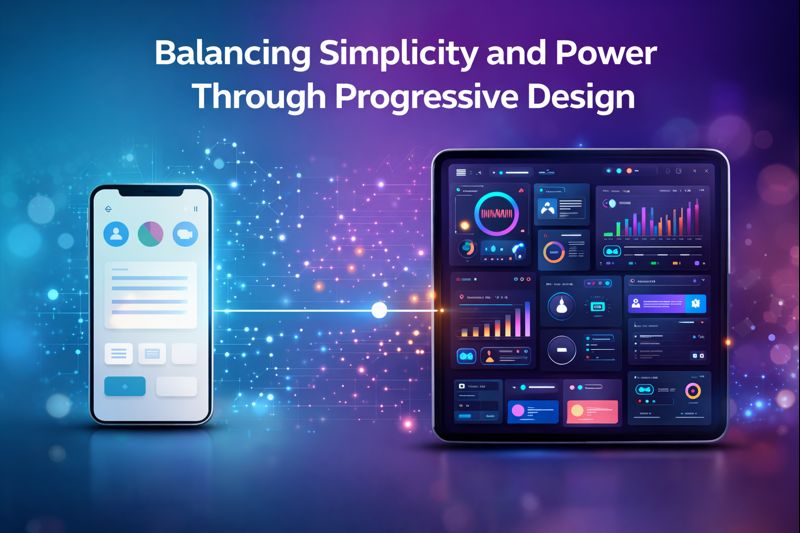
    Balancing Simplicity and Power Through Progressive Design

    Progressive design is a key UI and UX design principle in SaaS. Rather than overwhelming users, features appear as needed.

    This is accomplished through:

    • Role-based interfaces.
    • Contextual menus
    • Adaptive dashboards
    UI and UX design balancing

    As a result, beginners perceive simplicity, while advanced users gain power over time.

    UI and UX Design Impact on Retention and Revenue

    Retention is the true success metric for SaaS applications. Strong UI and UX design reduces churn by making products easier to use and more difficult to replace.

    Additionally:

    • Fewer support tickets result in lower costs.
    • Better usability boosts upsell adoption.
    • Consistent experience builds brand trust.

    Investing in UI and UX design has a direct impact on revenue growth.

    Future of UI and UX Design in SaaS (2026 and Beyond)

    Looking ahead, SaaS UI and UX design will focus on:

    • Voice-based interactions
    • Context-aware interfaces.
    • Emotionally responsive design
    • Cross-device continuity.

    As SaaS products get smarter, design will serve as a link between human intent and machine intelligence.

    Conclusion

    The defining challenge of SaaS design is to strike the right balance between simplicity and power. Even the most advanced SaaS platforms fail to provide value unless they have SaaS products that become intuitive, scalable, and profitable when they are designed with a user-centric, data-driven, and future-ready mindset. In 2026, UI and UX design are no longer optional; they are fundamental. 

  • How Salesforce Implementation Services Enable Cross-Department Revenue Intelligence at Scale

    How Salesforce Implementation Services Enable Cross-Department Revenue Intelligence at Scale

    Introduction

    Salesforce Implementation Services

    Large organizations generate massive amounts of revenue data, yet most leadership teams still lack a clear and reliable revenue picture. Sales, marketing, service, and finance often operate on disconnected systems, resulting in delayed insights and inconsistent forecasts.

    Salesforce Implementation Services address this issue by transforming Salesforce into a centralized revenue intelligence solution. Salesforce evolves from a departmental CRM to an operational backbone that connects revenue data across teams, systems, and regions on a large scale.

    The Real Revenue Intelligence Problem in Enterprises

    Revenue intelligence fails when departments work independently. Sales monitors opportunities, marketing focuses on campaign metrics, service manages tickets, and finance handles billing. However, these data streams rarely appear in real time.

    As a result, leaders make decisions based on incomplete or outdated information. Even companies that make significant investments in Salesforce licenses fail to see results because implementation is viewed as a technical setup rather than a business architecture initiative.

    This is where Salesforce Implementation Services play a critical role.

    Salesforce Implementation Services as a Revenue Intelligence Engine

    At the enterprise level, Salesforce must serve as an intelligence system rather than an engagement system. Proper implementation prioritizes revenue flow over features.

    A Salesforce implementation specialist starts by mapping out how revenue flows through the organization, from lead generation to deal closure, invoicing, renewals, and expansion. This ensures that Salesforce accurately reflects actual business behavior, rather than assumptions.

    Because of this structured approach, Salesforce transforms into a live revenue system rather than a reporting tool.

    Connecting Departments Through a Unified Revenue Model

    Cross-departmental revenue intelligence necessitates a common data model. Salesforce Implementation Services creates Salesforce objects, workflows, and permissions to ensure that all teams contribute to the same revenue narrative.

    For instance:

    • Marketing attribution is directly related to closed deals.
    • Service interactions affect renewal forecasting.
    • Finance data validates the actual revenue recognition.

    As a result, revenue insights become accurate, timely, and actionable across departments.

    Why Salesforce Consulting Is Central to Revenue Alignment

    Salesforce consulting fills the gap between business strategy and system implementation. Consultants examine how teams function today and how revenue decisions should be made in the future.

    Rather than configuring Salesforce in isolation, Salesforce consulting integrates CRM design with organizational KPIs. This reduces friction between teams and boosts long-term adoption.

    Furthermore, consulting-led implementations prevent excessive customization and ensure Salesforce’s scalability as the business grows.

    Role of a Salesforce Integration Consultant in Revenue Intelligence

    Revenue intelligence cannot exist without integration. A Salesforce integration consultant ensures Salesforce communicates seamlessly with ERP systems, marketing platforms, analytics tools, and data warehouses.

    This integration enables:

    • Real-time revenue validation from finance systems
    • Campaign performance tied to actual revenue
    • Support data connected to churn prediction

    As a result, Salesforce becomes the single source of truth for revenue decisions.

    Salesforce Implementation Partner vs Internal Execution

    Many enterprises attempt Salesforce implementation internally. While internal teams understand business context, they often lack experience with complex, multi-cloud, and global deployments.

    A certified Salesforce implementation partner brings tested frameworks, industry-specific expertise, and governance models. These partners have delivered similar implementations across regions and industries, reducing execution risk.

    Additionally, experienced Salesforce partner companies stay aligned with Salesforce platform updates, ensuring long-term system relevance.

    Revenue Intelligence Across Salesforce Clouds

    Modern Salesforce Implementation Services connect multiple Salesforce clouds into a single revenue ecosystem.

    Sales Cloud

    Sales Cloud tracks pipeline movement, deal velocity, and forecast accuracy. When implemented correctly, it provides real-time revenue visibility.

    Marketing Cloud and Data Cloud

    Marketing engagement data is connected directly to revenue outcomes, enabling true attribution modeling.

    Service Cloud

    Customer service performance influences renewal probability and lifetime value predictions.

    Revenue Cloud

    Subscriptions, pricing, billing, and renewals are unified, supporting recurring revenue models.

    AI-Driven Revenue Intelligence (2026 Outlook)

    By 2026, revenue intelligence will be predictive rather than reactive. Salesforce Implementation Services increasingly leverage Einstein AI and Data Cloud capabilities to support advanced analytics.

    AI-powered revenue intelligence includes:

    • Predictive pipeline scoring
    • Churn risk identification
    • Automated forecast adjustments

    However, AI accuracy depends on implementation quality. Without clean, integrated data, AI insights remain unreliable.

    Governance and Data Ownership at Scale

    Enterprise revenue intelligence requires strict governance. Salesforce Implementation Services define ownership rules, validation logic, and audit trails across departments.

    Governance frameworks ensure:

    • Data consistency across regions
    • Clear accountability for revenue changes
    • Compliance with internal and regulatory standards

    Because of strong governance, leadership can trust the data driving revenue decisions.

    Measuring ROI Beyond CRM Adoption

    Organizations often measure Salesforce success by user adoption. However, true ROI comes from revenue outcomes.

    Key performance indicators include:

    • Forecast accuracy improvement
    • Reduced sales cycle length
    • Increased renewal rates
    • Higher average deal value

    A strong Salesforce implementation partner aligns technical metrics with financial performance.

    Common Mistakes That Limit Revenue Intelligence

    Even with Salesforce in place, revenue intelligence fails due to poor execution.

    Common issues include:

    • Treating Salesforce as a sales-only system
    • Weak integration strategy
    • Over-customization without governance

    Salesforce consulting helps avoid these mistakes by focusing on long-term architecture rather than short-term fixes.

    Choosing the Right Salesforce Partner Companies

    Not all Salesforce partner companies deliver enterprise-grade solutions. Selection should be based on architecture capability, integration experience, and post-implementation support.

    Organizations should evaluate:

    • Industry experience
    • Data and AI readiness
    • Governance expertise

    Choosing the right partner directly impacts revenue intelligence success.

    The Future of Revenue Intelligence with Salesforce

    In the coming years, Salesforce will function as a digital revenue core. Salesforce Implementation Services will evolve from system configuration to intelligence orchestration.

    Enterprises that invest in structured implementation today will gain a long-term competitive advantage. Salesforce will no longer support revenue decisions—it will drive them.

    Conclusion

    Salesforce Implementation Services enable cross-department revenue intelligence by unifying data, processes, and teams into a single operational platform. When implemented strategically, Salesforce supports predictable growth, accurate forecasting, and scalable decision-making.

    Organizations that treat Salesforce as an enterprise intelligence system will lead revenue performance in the future

  • React Native Development Services in Enterprise-Scale Smart City and IoT Systems

    React Native Development Services in Enterprise-Scale Smart City and IoT Systems

    Introduction

    Mobile applications are no longer considered standalone products. In large-scale smart cities and IoT-driven environments, mobile apps serve as operational interfaces for distributed systems, cloud platforms, and real-time data pipelines. In this context, technology decisions are made based on long-term system behavior, scalability, and organizational efficiency rather than features or frameworks.

    React Native development services are increasingly being integrated into enterprise mobile strategies, not as a shortcut, but as an architectural choice. Organizations deploying IoT-connected platforms use React Native to integrate mobile delivery with modern backend, DevOps, and data-driven ecosystems.

    react native development services

    React Native’s Shift from Framework to Strategic Layer

    At the industrial level, React Native is no longer considered a “cross-platform tool.” It is viewed as a presentation and interaction layer that sits atop complex infrastructures like IoT networks, edge devices, cloud services, and analytics engines.

    Companies are separating concerns more aggressively than before. Business logic, data processing, and device communication occur outside of the mobile app, whereas React Native applications focus on orchestration, visualization, and user interaction. This separation enables mobile systems to evolve without disrupting the core infrastructure.

    This architectural role is one of the primary reasons why React Native app development services are being used in long-term smart city initiatives rather than short-term pilots.

    Enterprise Mobile Architecture in IoT-Connected Environments

    Mobile applications rarely interact directly with IoT devices. Instead, they use APIs, event streams, and control layers to aggregate sensor data and system state. React Native fits naturally into this model because it is designed to be API-first.

    Modern mobile architectures are increasingly based on:

    • Data flows triggered by an event
    • Communication is asynchronous.
    • Real-time state synchronization.

    React Native supports these patterns without requiring teams to keep separate Android and iOS implementations. This reduces fragmentation and keeps mobile interfaces in sync with backend evolution.

    This alignment is critical in smart city environments because infrastructure systems are constantly changing.

    Organizational Impact on Engineering Teams

    One of the most significant React Native-driven changes is organizational rather than technical. Enterprises using React Native are reshaping the way mobile teams operate.

    Instead of maintaining separate Android and iOS teams, businesses are transitioning to unified mobile engineering groups that share code, tooling, and release cycles. This reduces internal friction and enhances cross-functional collaboration between the backend and frontend teams.

    This shift has a direct impact on the following business aspects:

    • Time-to-market
    • Engineering Cost Predictability
    • Knowledge retention.
    • Long-term maintenance planning.

    This is a major reason why businesses continue to hire React Native developers even when native expertise is already available in-house.

    React Native in Real-Time Operational Systems

    Smart city platforms are based on real-time awareness. Traffic management, energy monitoring, public services, and infrastructure control systems necessitate mobile interfaces that can respond quickly to system changes.

    React Native applications are increasingly being used as operational dashboards, rather than consumer-facing apps. These dashboards collect live data, display system status, and initiate actions across multiple distributed systems.

    In such use cases, performance is measured not in animations or user interface polish, but in

    • Data Freshness
    • Interaction responsiveness
    • Stability under continuous updates

    Experienced React Native developers focus on managing state, rendering efficiency, and background processing to meet these operational demands.

    Integration with Cloud, Edge, and AI Systems

    By 2026, cloud-native architectures and edge computing will be thoroughly integrated into smart city platforms. Instead of acting as separate logic containers, mobile applications function as clients of these systems.

    React Native works well with:

    • Web-based APIs
    • Edge processing nodes
    • AI-powered analytics systems

    This enables mobile apps to be lightweight while also supporting advanced features like predictive alerts, anomaly detection, and automated decision workflows.

    The role of React Native is not to process intelligence but to present intelligence in a usable and reliable format.

    Why Enterprises Choose React Native Over Fully Native Stacks

    At the scale, technology decisions are influenced by consistency and sustainability, rather than theoretical performance differences. Enterprises that use React Native development services prioritize operational stability over marginal gains.

    Fully native stacks add long-term complexity:

    • Duplicate feature development.
    • Parallel Quality Assurance processes
    • Fragmented release pipelines.

    React Native reduces duplication while retaining native module support where hardware-level access is required. This hybrid approach gives enterprises control without imposing rigidity.

    For smart city and IoT-connected systems, this balance is frequently more important than platform-specific optimizations.

    Role of React Native Development Companies in Large Programs

    Large-scale initiatives frequently include multiple stakeholders, regulatory requirements, and lengthy delivery timelines. Partnering with a React Native development company gives you access to structured delivery models and accumulated expertise.

    These companies have experience in:

    • Managing big codebases
    • Coordinating multiple release roadmaps.
    • Ensure security and compliance.
    • Supporting long-term maintenance.

    For governments and businesses, this lowers execution risk and improves project continuity across phases.

    Native Capabilities Within React Native Systems

    Although React Native focuses on shared code, industrial systems still require direct access to device capabilities like sensors, location services, and secure storage. React Native facilitates this through native modules that seamlessly integrate with platform-specific code.

    This enables teams to maintain native mobile app development capabilities while preserving cross-platform efficiency. In IoT environments, this is critical for interacting with hardware-level features while keeping the application architecture consistent.

    React Native as an Interface for Infrastructure, Not Users

    The audience shift has been one of the most significant changes in how React Native is used today. Many React Native apps in smart city settings are not consumer products. They include internal tools, control interfaces, and monitoring systems.

    These apps prioritize:

    • Reliability trumps aesthetics
    • Data clarity over engagement
    • Prioritize operational accuracy over personalization.

    This shift is supported by React Native, which allows for rapid iteration while remaining stable in the face of constant system updates.

    Long-Term Maintainability and System Evolution

    Smart city platforms are designed to evolve over decades, not years. Mobile interfaces must adapt as infrastructure expands, regulations change, and new technologies emerge.

    The modular architecture of React Native enables teams to add new features, replace backend systems, or integrate additional services without having to rebuild the entire mobile layer. This makes React Native development service models ideal for long-term public and enterprise deployments.

    Maintenance becomes a managed process rather than a recurring crisis.

    React Native’s Position in the 2026 Technology Landscape

    By 2026, React Native will no longer compete with native development in terms of ideology. It competes for system compatibility, team efficiency, and architectural alignment.

    Enterprises choose React Native not because it is “easier,” but because it fits into modern software ecosystems based on APIs, cloud services, and continuous delivery.

    This positioning establishes React Native as a reliable option for organizations investing in connected, data-driven platforms.

    Strategic Value for Business and Governance

    For decision-makers, the value of React Native lies in predictability. Projects that use unified mobile architectures are easier to budget, manage, and scale.

    Governments and businesses that implement smart city systems benefit from

    • Consistent user interface
    • Quicker response to system changes.
    • Reduced reliance on platform-specific teams.

    These factors have a direct impact on the success of long-term digital initiatives.

    Conclusion

    React Native has grown from a development framework to a key component of enterprise mobile architecture. It serves as a stable interface layer in smart cities and IoT-connected environments, connecting complex systems to human operators.

    Organizations that use React Native development services benefit from architectural consistency, operational efficiency, and long-term flexibility. As smart systems grow in size and complexity, React Native’s role as an enterprise-ready mobile solution will become increasingly important.

  • Hardest Programming Language for Developers: Myth vs Real-World Challenges

    Hardest Programming Language for Developers: Myth vs Real-World Challenges

    Introduction

    Many developers look for the hardest programming language, as modern software development appears to be more challenging than ever. With the rise of cloud platforms, AI-powered systems, and distributed applications, even experienced engineers are encountering challenges that did not exist a few years ago.

    The problem is that most discussions oversimplify the difficulty. In 2026, programming language difficulty will no longer be measured by syntax or learning speed. It is about how well a language enables developers to handle modern system responsibilities while minimizing critical risks.

    hardest programming language

    Difficulty Does Vary, But Only to a Point

    It is widely acknowledged in both industry and academic circles that programming difficulty varies from developer to developer. The complexity of a language is influenced by its background, experience, and problem domain. However, this explanation is no longer enough.

    Even highly skilled developers in modern production environments struggle with specific languages due to external system pressures. This isn’t a matter of opinion; it has been observed repeatedly in large-scale engineering teams.

    Why Programming Languages Are Becoming Harder in 2026

    In 2026, software systems should be able to operate continuously, scale automatically, and remain secure in unpredictable conditions. These expectations have a direct impact on program complexity.

    Language difficulty increases when developers must manage

    • Cloud-native environment execution.
    • AI and Data-Driven Behavior
    • Failures occur in distributed systems.
    • Security and performance guarantees

    Languages that expose these responsibilities directly to developers are often described as the hardest programming languages to learn, not because they are poorly designed, but because they demand deeper system-level thinking.


    Cloud-Native Systems Increase Cognitive Load

    Modern applications are no longer deployed as separate units. They are divided into microservices, deployed in multiple regions, and scaled dynamically.

    Languages such as C++ and Rust have significant difficulties in such environments. Developers must focus on memory, concurrency, and failure handling, as well as cloud behaviors such as autoscaling and container orchestration.

    Industry engineering blogs and cloud incident reports frequently highlight how minor low-level errors in these languages can cause large-scale system failures. This is why they are often referred to as the most challenging programming language options for cloud-native systems.

    AI Integration Changes the Nature of Difficulty

    Artificial intelligence systems introduce nondeterministic behavior. In contrast to fixed logic, outputs are determined by data, models, and runtime conditions.

    In AI-heavy architectures, languages that require strict memory and execution control become more difficult to use safely. Developers using Rust or C++ in AI inference pipelines must simultaneously manage parallel workloads, latency constraints, and memory safety.

    This is a well-documented issue in industry discussions about AI infrastructure. As a result, these languages are frequently referred to as the most difficult coding language options available in AI-centric systems.

    Distributed Systems Make Errors Harder to Trace

    In distributed systems, failures can be expected. Network partitioning occurs, services fail, and data becomes temporarily inconsistent.

    Languages with low-level control but few abstractions force developers to handle these scenarios manually. Debugging such issues across multiple services is one of the most frequently mentioned pain points in real-world engineering postmortem reports.

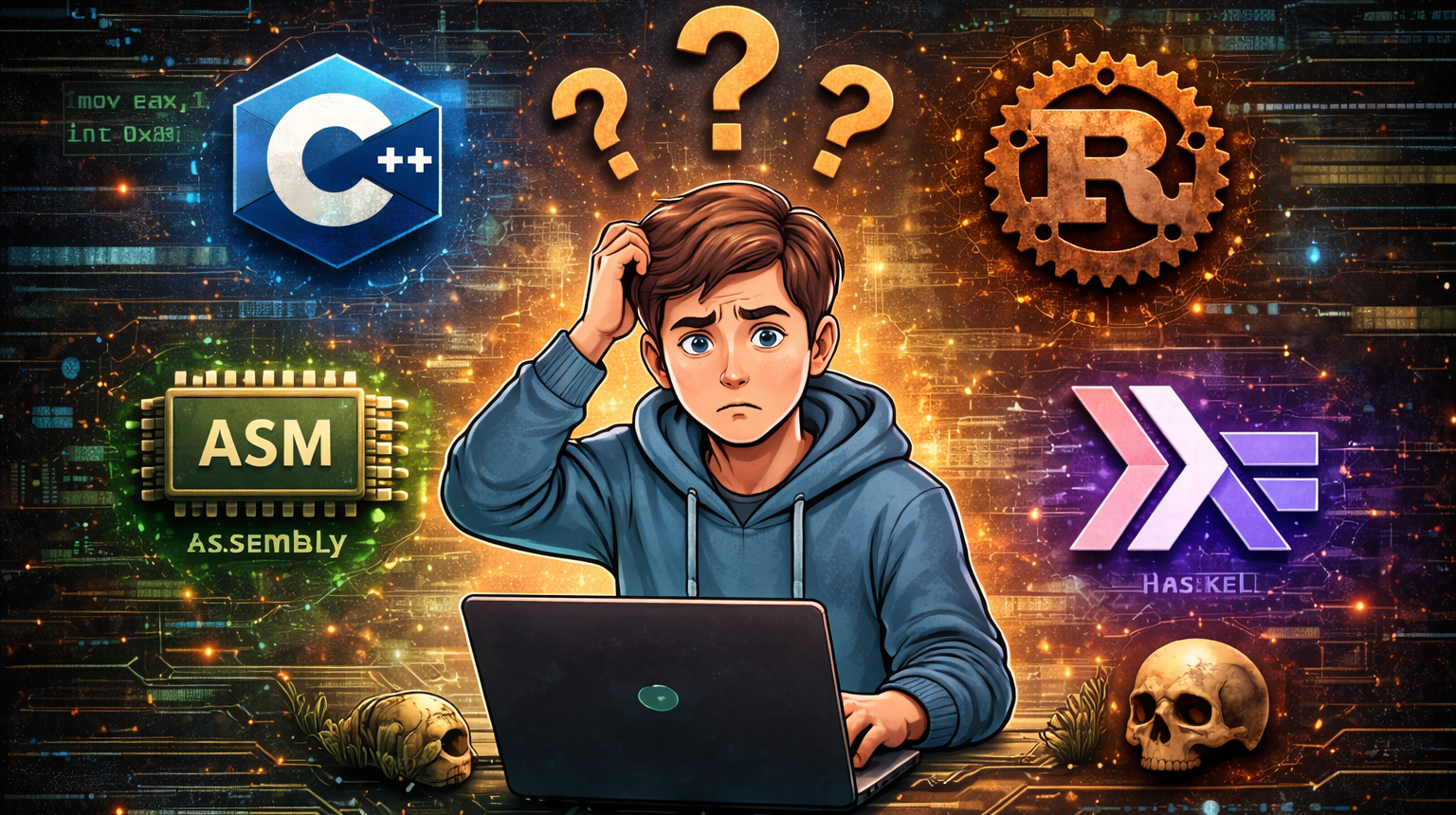
    This is the main reason why Assembly, C++, and Rust are consistently mentioned when discussing the hardest programming languages to learn for large-scale distributed systems.

    Security-by-Design Raises the Stakes

    Security is no longer a choice. Systems must be secure by default in 2026.

    Languages that allow unsafe memory operations impose greater responsibility on developers. A single mistake can expose serious vulnerabilities. According to industry security analyses, memory-related bugs remain one of the most costly types of software errors.

    Because of this, developers often ask, What is the hardest computer language to learn for secure system design?. Typically, the response indicates languages in which developers are responsible for enforcing security.

    So Which Programming Languages Will Actually Be the Hardest in 2026?

    The following languages are consistently demonstrated as the most challenging in real-world situations based on engineering experience, industry usage, and system requirements.

    C++

    C++ remains one of the most difficult programming languages due to its combination of performance requirements, manual memory management, and rising security expectations. In cloud and AI systems, the error margin is very minimal.

    Rust

    Rust is safer by design, but its ownership and lifetime models significantly raise the learning curve. Multiple industry surveys confirm that Rust reduces bugs but necessitates longer onboarding. This makes it the hardest programming language to learn for many developers new to modern systems programming.

    Assembly Language

    Assembly continues to be the toughest coding language because it offers no abstraction. In 2026, it is used only where absolute hardware control is required, making it extremely difficult to maintain and scale.

    Haskell (in Modern Architectures)

    Haskell becomes difficult to integrate into cloud and AI ecosystems. The challenge is not syntax but rather architectural integration and mental models. This ranks it among the hardest programming languages to learn in modern production environments.

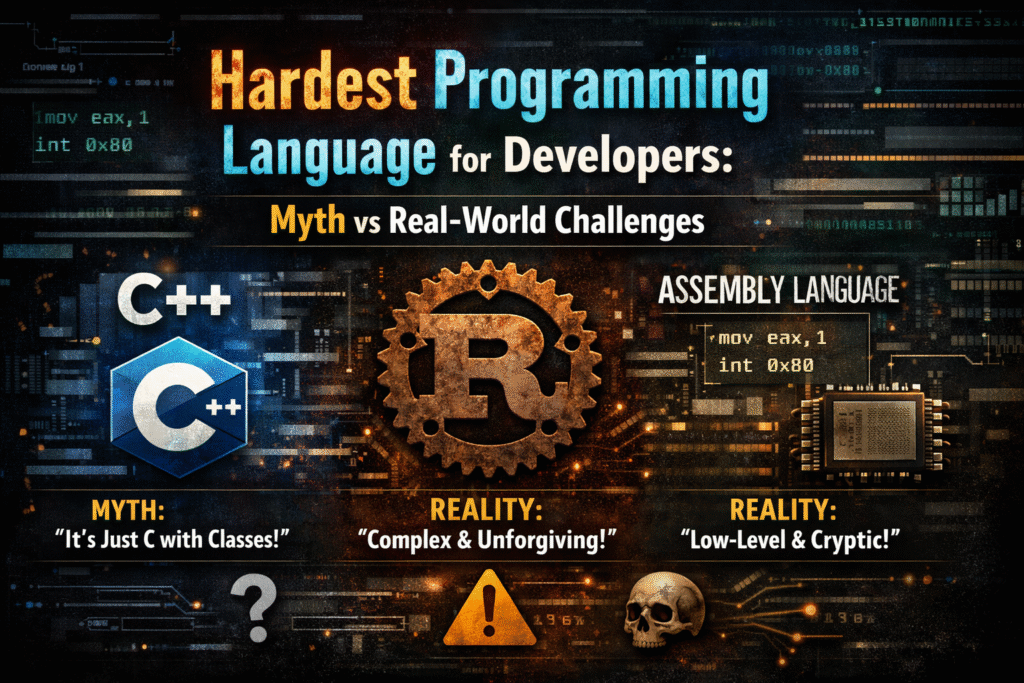
    Myth vs Reality

    According to the myth, the hardest coding language is inherently complex. In reality, languages become challenging when modern systems assign more responsibility to developers. A language earns the title of “toughest programming language” when it forces developers to simultaneously manage infrastructure behavior, AI logic, security risks, and performance constraints.

    Final Conclusion

    So, what is the hardest programming language in 2026?

    There is no single, universal answer. However, C++, Rust, Assembly, and Haskell consistently stand out as the most difficult to manage under modern demands such as AI integration, cloud-native execution, distributed reliability, and security-by-design.

    That is not a theoretical difficulty. It is monitored, documented, and experienced by developers throughout the industry.

  • AI Chatbot Conversations Archive: Persistent Memory Architecture for Advanced AI Systems

    AI Chatbot Conversations Archive: Persistent Memory Architecture for Advanced AI Systems

    Introduction

    AI chatbots are now embedded in research platforms, enterprise tools, public services, and startup products. While most chatbots today only store basic logs, advanced AI systems are moving toward structured conversation archives as a core intelligence layer. This results in weak learning continuity, limited accountability, and poor AI governance.

    An AI chatbot conversation archive addresses this issue by preserving interactions as structured, reusable intelligence. It enables long-term learning, regulatory traceability, and scalable AI development while maintaining data ownership.

    AI chatbot conversation archives

    Why Conversational Memory Is a Core AI Requirement

    Early chatbot systems were designed to generate immediate responses. When a conversation ended, its value was lost. This approach is inconsistent with modern AI systems, which must evolve, justify decisions, and adapt to real-world complexity.

    An AI chatbot conversation archive adds persistent memory to conversational systems. It tracks interaction context, intent interpretation, and system behavior over time. This enables AI models to learn from previous interactions while maintaining consistency across sessions. By 2026, persistent conversational memory will be a requirement rather than an option.

    Architectural Model of an AI Chatbot Conversations Archive

    A conversation archive functions as a distributed intelligence layer at a higher level. It is intended to record conversational real-time events, normalize them, and store them in a format that can be analyzed and used again in the future.

    Every conversational turn is recorded as a structured event with model state, context references, and semantic meaning. This guarantees that even when AI models evolve, recorded conversations will still be comprehensible.

    Key architectural elements include:

    • Conversation capture based on events in real time
    • Creation of semantic embeddings for every interaction
    • Hybrid storage with vector databases and object storage

    Both operational and research-level use cases can be supported by archived data thanks to this architecture.

    Semantic Storage and Vector-Based Retrieval

    Traditional keyword storage fails when it comes to large amounts of conversational data. Advanced AI chatbot conversation archive systems use vectorized storage to preserve meaning rather than surface text. Each interaction is converted into an embedding that captures intent, tone, and context. These embeddings enable semantic search, allowing systems to retrieve conversations based on similarity rather than precise phrasing.

    For researchers, it enables large-scale analysis of interaction patterns. It allows startups to iterate faster by identifying recurring issues and hidden user needs. Semantic storage changes the archive from a passive log to an active intelligence system.

    Continuous Learning and Feedback Loops

    One of the most important functions of an AI chatbot conversation archive is to facilitate managed continuous learning. Rather than retraining models on static datasets, modern systems learn from actual user interactions.

    Archived conversations are filtered to identify uncertainty, failures, or incomplete responses. These interactions are then reviewed, annotated, or automatically classified before being used in training pipelines.

    Advanced learning workflows typically include:

    • Detecting low confidence or failed interactions
    • Selective annotation, either automated or human.
    • Controlled reintroduction to training datasets

    This process increases accuracy while preventing uncontrolled model drift.

    Governance, Accountability, and Explainability

    AI systems are increasingly expected to clarify their behavior. Conversation archives provide the necessary evidence for explainable and auditable AI.

    An AI chatbot conversation archive tracks which model version responded, what context was available, and how intent was interpreted at the time. This traceability facilitates internal audits, regulatory reviews, and ethical assessments.

    AI behavior is hard to defend without an archive, especially in regulated sectors such as healthcare, finance, and education.

    Research and Academic Significance

    For academics and AI researchers, archived chatbot conversations provide authentic longitudinal datasets. These datasets capture real-world ambiguity, changing language usage, and shifting user expectations.

    Researchers can investigate bias emergence, context retention, response stability, and model evolution over time. Archived data also makes reproducible research possible by preserving interaction conditions and system state. An AI chatbot conversation archive serves as a foundational research asset rather than a technical byproduct.

    Strategic Value for Startups and Enterprises

    Startups developing AI-first products frequently face difficulties in scaling intelligence responsibly. Conversation archives help to address this issue by converting interactions into structured information. Organizations can identify product gaps, unmet user needs, and failure patterns by analyzing archived conversations. Over time, this data evolves into a proprietary intelligence resource.

    Organizations can identify product gaps, unmet user needs, and failure patterns by analyzing archived conversations. Over time, this data evolves into a proprietary intelligence resource.

    From a business perspective, archives support:

    • Better product decision-making.
    • Reduced support errors.
    • Increased trust among users and investors

    This elevates conversation archiving to a strategic capability rather than a backend feature.

    Privacy, Ethics, and Data Control

    Archiving conversations introduces ethical and legal responsibilities. Advanced systems incorporate privacy protection directly into the archive design. Semantic anonymization, role-based access control, and automated retention policies all help to balance data utility and user trust. Sensitive information is removed or masked to preserve analytical value. By 2026, privacy-conscious conversation archives will be critical to regulatory compliance and ethical AI deployment.

    Integration with AI Observability Systems

    Modern AI systems require observability to track behavior and detect drift. Conversation archives contain historical context that observability tools alone cannot capture.

    By comparing live behavior to archived interactions, systems can detect anomalies, enforce safety limits, and track long-term trends. This integration allows for proactive AI control, rather than reactive troubleshooting. An AI chatbot conversation archive improves system reliability by basing monitoring on historical evidence.

    AI chatbot conversations archive

    Risks and Long-Term Challenges

    Regardless of their value, conversation archives present long-term challenges. Poor curation can exacerbate bias. Excessive retention increases both cost and environmental impact. Fragmented governance can result in compliance gaps.

    Key risks that need to be managed include:

    • Biases accumulate over time.
    • Poor labeling and data contamination.
    • Uncontrollable data growth

    These risks necessitate active archive management rather than passive storage.

    The Future: From Archive to AI Institutional Memory

    Looking ahead to 2026 and beyond, AI chatbot conversation archive systems will transform into institutional memory layers. They will bring conversations together across products, models, and time.

    These systems will enable cross-model learning, long-term reasoning, and organizational knowledge reliability. AI will no longer respond solely to current input but will also reason based on previous conversational experiences.

    This shift represents a move from transactional chatbots to persistent conversational intelligence systems.

    Conclusion

    An AI chatbot conversation archive is more than just a data storage tool. The memory system enables accountable, scalable, and intelligent AI.

    It offers researchers real-world data. For startups, it provides competitive insight. It establishes continuity and trust in future AI ecosystems. Organizations that invest in advanced conversation archiving today are laying the groundwork for next-generation AI.

  • DeepSeek vs ChatGPT: A Practical AI Comparison for 2026

    DeepSeek vs ChatGPT: A Practical AI Comparison for 2026

    Introduction

    Choosing the right AI model has become a real challenge for researchers, startups, and technical teams. Many users adopt an AI tool based on trends, only to discover later that it does not fit their actual workload or long-term goals.

    This blog helps you determine which AI model is better suited for research, startups, and future-ready applications by providing a clear, useful, and current comparison of DeepSeek vs. ChatGPT.

    deepseek vs chatgpt

    Why the DeepSeek vs ChatGPT Debate Matters Today

    The debate over DeepSeek vs. ChatGPT is accelerating as AI advances beyond simple conversations. In 2026, AI tools will play a significant role in research workflows, software development, and business decisions.

    ChatGPT has presented itself as a versatile AI that can perform a wide range of tasks. In contrast, DeepSeek has drawn notice for its cost-effectiveness and technical focus. This difference leads users to ask which is better, DeepSeek or ChatGPT, instead of assuming one universal solution.

    Core Difference Between DeepSeek and ChatGPT

    The difference between DeepSeek and ChatGPT lies in how each model is designed and optimized.

    ChatGPT prioritizes language understanding, long-context reasoning, and clarity in responses. It is built to assist users across writing, research, coding, and business tasks while maintaining consistency.

    DeepSeek focuses on logical precision, computational efficiency, and technical accuracy. It is frequently used for algorithm-based tasks and structured problem solving. This is why some users conclude that DeepSeek is better than ChatGPT in narrowly defined technical scenarios.

    DeepSeek vs ChatGPT: Side-by-Side Comparison

    AspectDeepSeekChatGPT
    Core FocusTechnical reasoning & efficiencyLanguage reasoning & versatility
    Best UseAlgorithms, math, optimizationResearch, writing, startups
    Ease of UseMore technicalUser-friendly
    Accuracy StyleTask-specific precisionConsistent across domains
    Cost PositioningMore budget-friendlyPremium ecosystem

    This comparison explains why ChatGPT vs. DeepSeek searches are increasing rather than declining.

    Real-World Use Cases That Matter

    DeepSeek performs well in environments where accuracy and computation matter more than conversation. It supports algorithmic research, numerical analysis, and performance-focused development tasks. For teams working under cost constraints, DeepSeek can be a practical choice.

    ChatGPT is ideal for research writing, startup workflows, customer interaction, documentation, and idea generation. Its ability to clearly explain concepts makes it useful across various domains. These distinctions naturally raise questions like, “Is DeepSeek better than ChatGPT?” 

    DeepSeek vs ChatGPT for Research and Scholars

    Researchers require AI that is dependable, understandable, and adaptable. ChatGPT assists scholars with literature reviews, structured explanations, writing research content, and refining arguments. Its outputs are easier to adjust to academic standards and interdisciplinary research.

    DeepSeek is useful in research areas that require calculations, simulations, and algorithmic models. ChatGPT, on the other hand, continues to be more useful for qualitative or mixed research. That is why many people ask how DeepSeek is different from ChatGPT in academic settings.

    Startup and Business Perspective

    From the perspective of a startup, AI must be scalable and integrated into daily operations. ChatGPT is well suited to startup environments that require automation, internal knowledge support, and AI-assisted decision-making. Its ecosystem streamlines deployment across teams. DeepSeek appeals to startups that prioritize engineering efficiency and cost control. This leads many founders to compare DeepSeek cost vs ChatGPT before choosing a long-term AI solution.

    Pricing and Cost Considerations

    When comparing DeepSeek vs. ChatGPT pricing, the difference is noticeable. ChatGPT typically provides more advanced features and enterprise-level reliability at a higher cost. DeepSeek positions itself as a more cost-effective solution, particularly for technical workloads. This pricing disparity explains the growing interest in DeepSeek vs. ChatGPT cost comparisons.

    Coding and Technical Performance

    Developers frequently compare DeepSeek vs. ChatGPT coding performance based on how each tool fits into their workflow.

    ChatGPT assists developers by explaining code logic, debugging issues, and guiding architectural decisions. It helps teams learn and collaborate.

    DeepSeek excels in logic-intensive coding and optimization tasks. This makes the comparison between GPT and DeepSeek relevant for developers working on performance-critical systems.

    Accuracy, Reliability, and Trust

    A common question is, is DeepSeek really better than ChatGPT in terms of accuracy?

    • ChatGPT produces consistent results in both technical and non-technical domains, making it appropriate for mixed workloads such as research, writing, and business applications.
    • DeepSeek can outperform ChatGPT in certain technical and logic-based tasks, especially when calculations or structured reasoning are required.
    • Flexibility is where the difference becomes clear, as DeepSeek may struggle outside of narrowly defined technical scenarios.

    For balanced, long-term usage across multiple domains, ChatGPT remains the more reliable option.

    Future Outlook: DeepSeek and ChatGPT Beyond 2026

    By 2026, AI systems will play a critical role in accelerating research, growing startups, and automating workflows.

    ChatGPT is focusing on multimodal intelligence, enterprise adoption, and more secure AI interactions. DeepSeek is improving its efficiency, technical performance, and broader research application. This future direction keeps the question of whether ChatGPT or DeepSeek is preferable relevant rather than resolved.

    Final Decision: Which One Should You Choose?

    deepseek vs chatgpt

    Choose ChatGPT if your job requires research writing, startup operations, multidisciplinary tasks, or long-term scalability. Choose DeepSeek if you’re looking for algorithmic accuracy, technical computation, or cost-effective AI usage.So, which is better: DeepSeek or ChatGPT? The answer is entirely dependent on your use case

  • Edge Computing vs Cloud Computing in 5G and AI Workloads

    Edge Computing vs Cloud Computing in 5G and AI Workloads

    Introduction

    Modern AI workloads and 5G networks require real-time responses, continuous availability, and scalable infrastructures. However, many systems continue to rely on centralized cloud models, which suffer from latency, bandwidth constraints, and delayed decision-making.

    To address this issue, organizations are now comparing edge computing and cloud computing as separate but interconnected computing models. When properly designed, enterprise-grade cloud engineering services allow startups, researchers, and enterprises to strike a balance between speed, scale, and intelligence while maintaining performance and compliance.

    edge computing vs cloud computing

    Understanding Edge Computing vs Cloud Computing

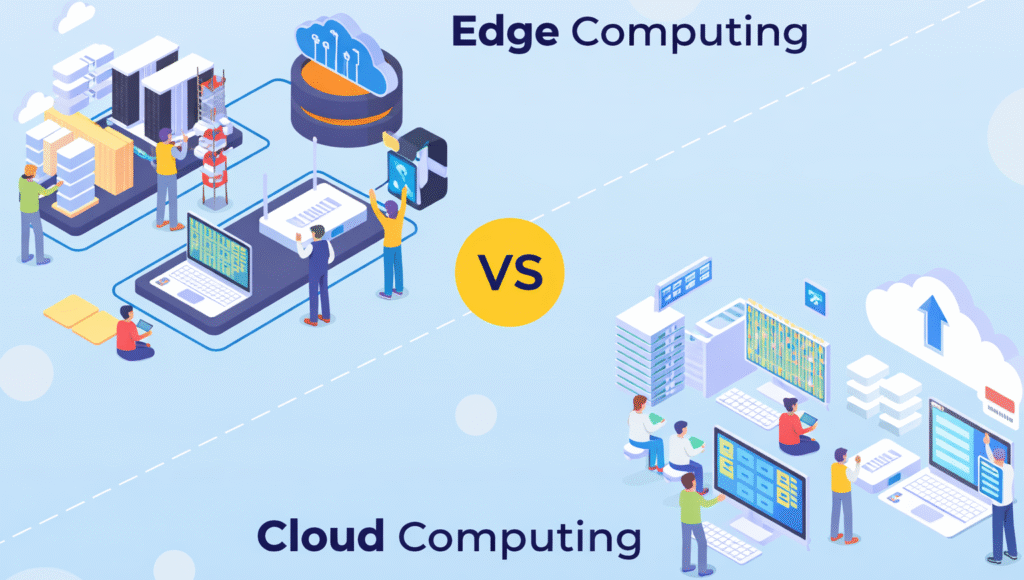
    Before comparing use cases, it’s important to understand how both models work. Cloud computing is built on centralized data centers that are remotely controlled for networking, storage, and processing. Edge computing, on the other hand, works with data in proximity to its source, such as local edge servers, sensors, or devices.

    As a result, cloud computing vs. edge computing cannot be a substitute for each other. Instead, it involves determining where computation should take place based on workload demands.

    Role of 5G in Modern Computing Architectures

    5G networks offer extremely low latency, high throughput, and widespread device connectivity. As a result, they facilitate real-time communication among machines, applications, and users. However, sending all 5G-generated data to a remote cloud computing server reduces the practical utility of 5G.

    Cloud-based processing may not always satisfy real-time requirements due to physical distance. Edge computing closes this gap by processing time-sensitive data locally, whereas cloud platforms handle aggregation and intelligence. Thus, in 5G systems, edge computing vs cloud computing is a layered execution model rather than a single deployment option.

    AI Workloads: Execution of Inference vs. Training

    Depending on their purpose, AI workloads exhibit distinct behaviors.

    Using Cloud Computing to Train AI

    Cloud computing platforms are perfect for:

    • Training models on a large scale
    • GPU workloads with high performance
    • Analytics of long-term data
    • Centralized monitoring of experiments

    Virtualization in cloud computing is crucial in this situation. Researchers and cloud computing engineers can scale compute resources dynamically thanks to virtualized environments.

    Edge Computing for AI Inference.

    On the other hand, AI inference needs:

    • Immediate decision-making
    • Continuous availability.
    • Low-latency responses

    Edge computing enables inference to run close to devices, allowing for real-time systems such as autonomous machines and monitoring platforms. Therefore, the distinction between edge computing and cloud computing for AI workloads is functional rather than competitive.

    Latency and reliability considerations

    Latency directly affects system reliability. When data travels over long distances to a cloud computing server, delays occur due to network congestion and routing paths.

    Edge computing reduces this delay by executing logic close to the data source. As a result, systems become more resilient even when the network is unstable.

    Latency is the most important technical factor influencing edge computing vs cloud computing decisions in architectures ready for 2026.

    Data Governance and Security in Distributed Systems

    Security requirements are becoming stricter due to global data regulations. Cloud platforms offer strong centralized security controls, identity management, and audit capabilities.

    However, continuous data transmission increases the possibility of exposure. Edge computing reduces the risk by storing sensitive data locally. However, managing security across distributed nodes necessitates automated governance frameworks.

    Therefore, the security of edge computing vs cloud computing depends on centralized policy enforcement with distributed execution, often managed through cloud-based orchestration layers.

    Benefits of Cloud Computing

    Despite edge growth, the benefits of cloud computing remain critical.

    Key advantages include

    • Scalability can be elastic.
    • Global accessibility.
    • Strong ecosystem support

    Cloud computing providers offer advanced services for analytics, AI pipelines, DevOps, and collaboration. For startups and scholars, this reduces infrastructure barriers and accelerates experimentation. Because of these benefits, cloud platforms remain essential even in edge-first architectures.

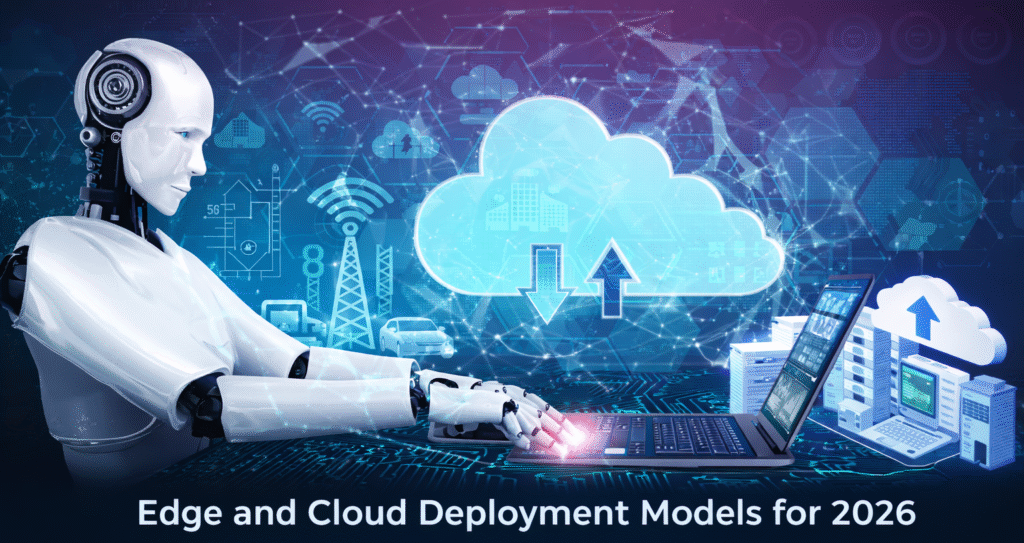
    Edge and Cloud Deployment Models for 2026

    Modern systems no longer use a single deployment model. Instead, they use hybrid architectures to distribute workload strategically.

    Hybrid execution methodology.

    • Edge nodes perform real-time AI inference.
    • Cloud systems manage training, analytics, and storage.
    • 5G networks connect edge locations efficiently.

    This design reflects how edge computing and cloud computing function in real-world production environments, particularly for research platforms and emerging startups.

    edge computing vs cloud computing

    Role of Cloud Computing Engineers

    The role of a cloud computing engineer is evolving, as are the architectures. Now, engineers must comprehend:

    • Models of distributed execution
    • Orchestration on the edge
    • Cloud computing virtualization
    • Automation of security in various environments

    Designing scalable AI and 5G systems increasingly requires this combination of skills.

    Use Cases Across Industries

    Edge Computing Use Cases

    • Autonomous vehicles
    • Industrial automation
    • Smart traffic systems
    • Real-time healthcare monitoring

    Cloud Computing Use Cases

    • AI model development
    • Research data aggregation
    • Software development and testing
    • Enterprise analytics platforms

    In practice, edge computing vs cloud computing becomes a workload placement strategy, not a technology choice.

    Cloud Computing Consulting

    Many startups lack the internal expertise to design distributed architectures. Cloud computing consulting assists organizations:

    • Choose the correct workload placement.
    • Optimize infrastructure cost
    • Implement security and compliance
    • Scale AI and 5G systems efficiently.

    Consulting allows researchers to ensure that their systems are reproducible, scalable, and cost-effective.

    Will Edge Computing Replace Cloud Computing?

    Cloud computing will not be replaced by edge computing. Instead, it increases cloud capabilities to meet demands instantly.

    The cloud remains the backbone for:

    • Centralized governance.
    • Data Aggregation
    • Advanced analytics
    • Long-Term Intelligence

    Therefore, edge computing vs cloud computing work together to develop a cooperative model that leads to distributed intelligence.

    Conclusion

    Modern AI and 5G systems require both speed and scalability. Edge computing enables local responsiveness, whereas cloud computing provides centralized intelligence and flexibility.

    Understanding edge computing vs cloud computing enables startups, researchers, and enterprises to design systems that are dependable, secure, and future-proof. The success of digital platforms in 2026 will be determined by the effective distribution of intelligence across edge and cloud layers.

  • How a Low-Code Platform Is Transforming Backend and System Architecture

    How a Low-Code Platform Is Transforming Backend and System Architecture

    Introduction

    Modern backend systems are becoming more difficult to design and maintain. Traditional development necessitates extensive knowledge of APIs, cloud services, security, and scaling, resulting in higher costs and slower innovation for startups and research teams.

    A low-code platform addresses this issue by abstracting backend complexity using intelligent system modeling, automation, and cloud-native execution. By 2026, these platforms will allow the low code development companies to design, deploy, and evolve backend architectures while maintaining technical control.

    low-code-platform

    Why Traditional Backends No Longer Scale

    Backend development has been shifted from simple server logic to a distributed architecture. Microservices, real-time data processing, and continuous integration pipelines are essential components of modern applications. However, manually developing these systems takes time, skilled engineers, and lengthy testing cycles.

    As a result, startups struggle to scale, and researchers experience delays in experimentation. Therefore, the low-code development future focuses on reducing architectural friction while maintaining system reliability.

    Core Technology: Low-Code Backend Transformation

    The transformation is more than just visual designs. It is powered by a variety of backend technologies that work together within modern low-code platform.

    Model-driven Architecture Engines 

    A low-code platform is fundamentally built on model-driven architecture (MDA). Rather than writing backend code first, developers define system behavior with structured models. These models illustrate services, data entities, and workflows.

    The platform converts these models into optimized backend code. As a result, system logic maintains consistency while allowing for rapid change.

    API Orchestration: Graph-Based Execution

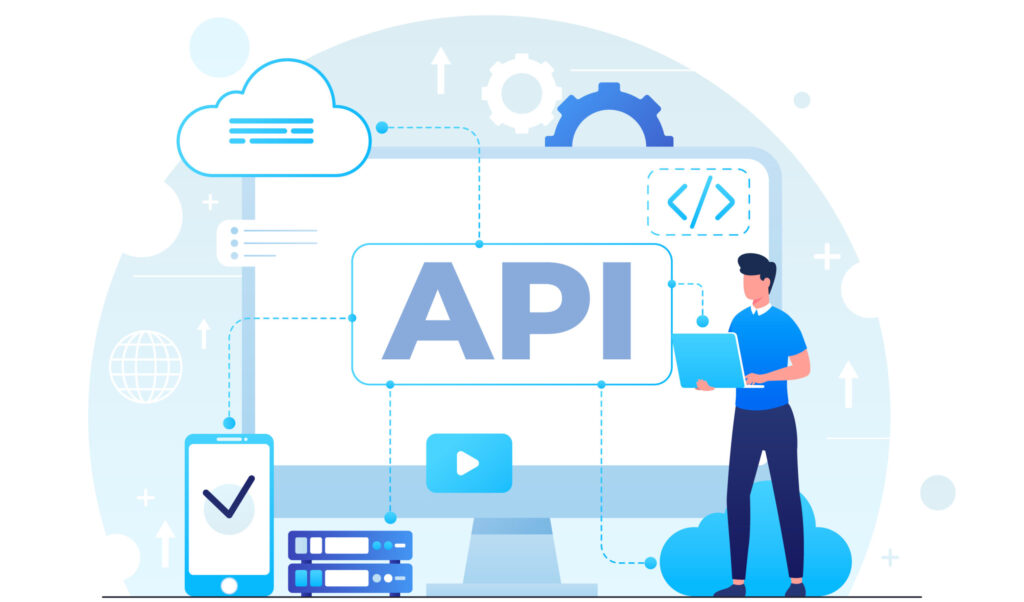
    In 2026, backend systems will rely heavily on APIs. Low-code platforms handle it with graph-based orchestration engines.Each API is treated like a node in a dependency graph.

    When a request is initiated, the platform determines the execution order independently. This method ensures efficient data flow and fault tolerance. These low-code development examples show how to manage complex integrations without manual wiring.

    Event-Driven Microservices Without Manual Configuration

    Modern low-code platforms support event-driven architecture through message brokers and async triggers. Instead of making direct service calls, backend components communicate through events. This enables systems to scale independently. Importantly, the platform creates event listeners, queues, and retry mechanisms effortlessly. Low-code app development is better suited to real-time and high-load environments.

    Cloud-Native Runtime Engines

    The cloud-native runtime layer is a key factor in why low-code platforms scale. In 2026, these platforms will deploy backend services via containers and serverless functions. They continuously monitor CPU usage, memory, and latency. When the load increases, instances scale automatically. As a result, startups avoid over-provisioning while still delivering performance.

    Data Layer Automation and Consistency

    Data management is an essential component of backend architecture. Low-code platforms now employ schema-aware data engines. These engines enforce data consistency rules during runtime. When data models change, migrations are created automatically. This reduces human error while improving system stability. This prevents data corruption while enabling researchers to iterate more quickly.

    Built-In Security by Architectural Design

    Security is built directly into backend workflows. Low-code platform security is based on policy-driven enforcement. Access rules are defined at the model level and apply to APIs, databases, and services. Audit logs and anomaly detection are also running continuously. As a result, security is unified rather than fragmented.

    Controlled Custom Code Injection

    Despite automation, a low-code platform does not replace developers. Instead, they promote controlled extensibility. Custom code can be injected into predefined extension points. This allows for performance optimization and experimental logic while maintaining system integrity. For a low-code app developer, this hybrid model provides flexibility without chaos.

    Benefits of Low-Code Development

    The benefits of low-code development become clearer at the system level:

    • Faster backend architecture design
    • Lower operating and maintenance costs.
    • Less dependence on large engineering teams.
    • Improved collaboration among technical and non-technical roles

    These benefits directly support startup growth and academic experimentation.

    Use in Startups, and Scalable Systems

    A Low-code platform enables researchers to rapidly build backends as prototypes and deploy them in controlled environments. Experiments allow for faster transitions from concept to production.

    Backend systems evolve as a startup’s product grows. Low-code website development and backend services can scale together, reducing initial technical debt.

    Governance and Long-Term Maintainability

    Version control, architectural validation, and performance monitoring are all standard features on modern platforms.Before deployment, systems are scanned for bottlenecks and security flaws. As a result, backend architectures remain manageable even as they scale.

    The Low-Code Development Future in 2026

    By 2026, low-code platforms will include AI-driven optimization. Systems will predict load patterns, make architectural recommendations, and automatically reduce failures. It is not a replacement for engineers. Instead, it shifts their responsibilities from manual builders to system designers and optimizers.

    low-code-platform

    Conclusion

    A low-code platform is revolutionizing backend and system architecture with model-driven design, API orchestration, event-based execution, and cloud-native runtimes. These technologies enable startups and researchers to build scalable backend systems while maintaining quality and control. The transformation does not involve shortcuts. It’s about creating smarter systems with fewer barriers and greater architectural discipline.