Introduction
Many developers look for the hardest programming language, as modern software development appears to be more challenging than ever. With the rise of cloud platforms, AI-powered systems, and distributed applications, even experienced engineers are encountering challenges that did not exist a few years ago.
The problem is that most discussions oversimplify the difficulty. In 2026, programming language difficulty will no longer be measured by syntax or learning speed. It is about how well a language enables developers to handle modern system responsibilities while minimizing critical risks.
Difficulty Does Vary, But Only to a Point
It is widely acknowledged in both industry and academic circles that programming difficulty varies from developer to developer. The complexity of a language is influenced by its background, experience, and problem domain. However, this explanation is no longer enough.
Even highly skilled developers in modern production environments struggle with specific languages due to external system pressures. This isn’t a matter of opinion; it has been observed repeatedly in large-scale engineering teams.
Why Programming Languages Are Becoming Harder in 2026
In 2026, software systems should be able to operate continuously, scale automatically, and remain secure in unpredictable conditions. These expectations have a direct impact on program complexity.
Language difficulty increases when developers must manage
- Cloud-native environment execution.
- AI and Data-Driven Behavior
- Failures occur in distributed systems.
- Security and performance guarantees
Languages that expose these responsibilities directly to developers are often described as the hardest programming languages to learn, not because they are poorly designed, but because they demand deeper system-level thinking.
Cloud-Native Systems Increase Cognitive Load
Modern applications are no longer deployed as separate units. They are divided into microservices, deployed in multiple regions, and scaled dynamically.
Languages such as C++ and Rust have significant difficulties in such environments. Developers must focus on memory, concurrency, and failure handling, as well as cloud behaviors such as autoscaling and container orchestration.
Industry engineering blogs and cloud incident reports frequently highlight how minor low-level errors in these languages can cause large-scale system failures. This is why they are often referred to as the most challenging programming language options for cloud-native systems.
AI Integration Changes the Nature of Difficulty
Artificial intelligence systems introduce nondeterministic behavior. In contrast to fixed logic, outputs are determined by data, models, and runtime conditions.
In AI-heavy architectures, languages that require strict memory and execution control become more difficult to use safely. Developers using Rust or C++ in AI inference pipelines must simultaneously manage parallel workloads, latency constraints, and memory safety.
This is a well-documented issue in industry discussions about AI infrastructure. As a result, these languages are frequently referred to as the most difficult coding language options available in AI-centric systems.
Distributed Systems Make Errors Harder to Trace
In distributed systems, failures can be expected. Network partitioning occurs, services fail, and data becomes temporarily inconsistent.
Languages with low-level control but few abstractions force developers to handle these scenarios manually. Debugging such issues across multiple services is one of the most frequently mentioned pain points in real-world engineering postmortem reports.
This is the main reason why Assembly, C++, and Rust are consistently mentioned when discussing the hardest programming languages to learn for large-scale distributed systems.
Security-by-Design Raises the Stakes
Security is no longer a choice. Systems must be secure by default in 2026.
Languages that allow unsafe memory operations impose greater responsibility on developers. A single mistake can expose serious vulnerabilities. According to industry security analyses, memory-related bugs remain one of the most costly types of software errors.
Because of this, developers often ask, What is the hardest computer language to learn for secure system design?. Typically, the response indicates languages in which developers are responsible for enforcing security.
So Which Programming Languages Will Actually Be the Hardest in 2026?

The following languages are consistently demonstrated as the most challenging in real-world situations based on engineering experience, industry usage, and system requirements.
C++
C++ remains one of the most difficult programming languages due to its combination of performance requirements, manual memory management, and rising security expectations. In cloud and AI systems, the error margin is very minimal.
Rust
Rust is safer by design, but its ownership and lifetime models significantly raise the learning curve. Multiple industry surveys confirm that Rust reduces bugs but necessitates longer onboarding. This makes it the hardest programming language to learn for many developers new to modern systems programming.
Assembly Language
Assembly continues to be the toughest coding language because it offers no abstraction. In 2026, it is used only where absolute hardware control is required, making it extremely difficult to maintain and scale.
Haskell (in Modern Architectures)
Haskell becomes difficult to integrate into cloud and AI ecosystems. The challenge is not syntax but rather architectural integration and mental models. This ranks it among the hardest programming languages to learn in modern production environments.
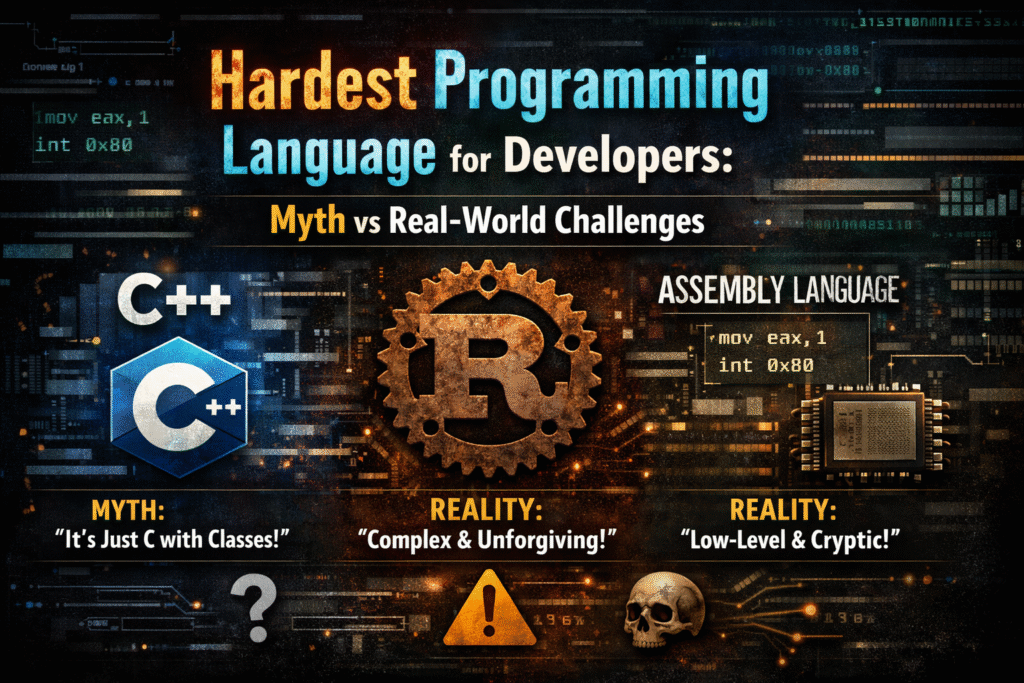
Myth vs Reality
According to the myth, the hardest coding language is inherently complex. In reality, languages become challenging when modern systems assign more responsibility to developers. A language earns the title of “toughest programming language” when it forces developers to simultaneously manage infrastructure behavior, AI logic, security risks, and performance constraints.
Final Conclusion
So, what is the hardest programming language in 2026?
There is no single, universal answer. However, C++, Rust, Assembly, and Haskell consistently stand out as the most difficult to manage under modern demands such as AI integration, cloud-native execution, distributed reliability, and security-by-design.
That is not a theoretical difficulty. It is monitored, documented, and experienced by developers throughout the industry.
Leave a Reply