Introduction
Modern DevOps pipelines rely heavily on encryption to protect code, secrets, and deployments. However, current cryptographic systems were designed before quantum computing became a real threat. Therefore, these systems could break when large quantum computers arrive.
That’s where post-quantum cryptography comes in: securing DevOps pipelines against quantum-era attacks without disrupting current workflows. By deploying quantum-resistant encryption in initial systems now, organisations can ensure they are reducing the long-term risk through secure DevOps pipeline implementation services.
Recognizing the Quantum Risk to DevOps Pipelines
Quantum computers are more than just faster devices. They use quantum mechanics to solve problems that traditional computers can’t handle. Many encryption methods used in CI/CD pipelines could become weak due to this.
Asymmetric encryption, for example, protects communication between pipeline stages, secrets, and API keys. However, quantum algorithms such as Shor’s algorithm can break these systems. Therefore, DevOps teams must rethink how cryptography is used in deployment and automation processes. This growing risk is the main reason why post-quantum cryptography is becoming a priority for modern DevOps pipelines.
What Is Post-Quantum Cryptography?
Post-quantum cryptography uses algorithms that stay secure even if quantum computers are used to attack them. These new methods are meant to replace current public-key systems and do not need any quantum hardware.
In contrast to experimental approaches, post-quantum solutions are available for immediate implementation. Standards organizations are finalizing algorithms expected to become global defaults by 2026. Early adoption thus provides a significant strategic advantage.
Why Quantum-Safe DevOps Matters in 2026
DevOps pipelines continuously handle sensitive data. Automated systems handle source code, secrets, credentials, and deployment artifacts. The whole software supply chain is vulnerable if encryption fails.
Furthermore, using quantum machines, attackers can gather encrypted data now and decrypt it later. This “store now, decrypt later” risk makes quantum encryption a current problem, not a future one. Consequently, DevOps teams must act before quantum hardware becomes mainstream.
Including Quantum-Resistant Cryptography in CI/CD
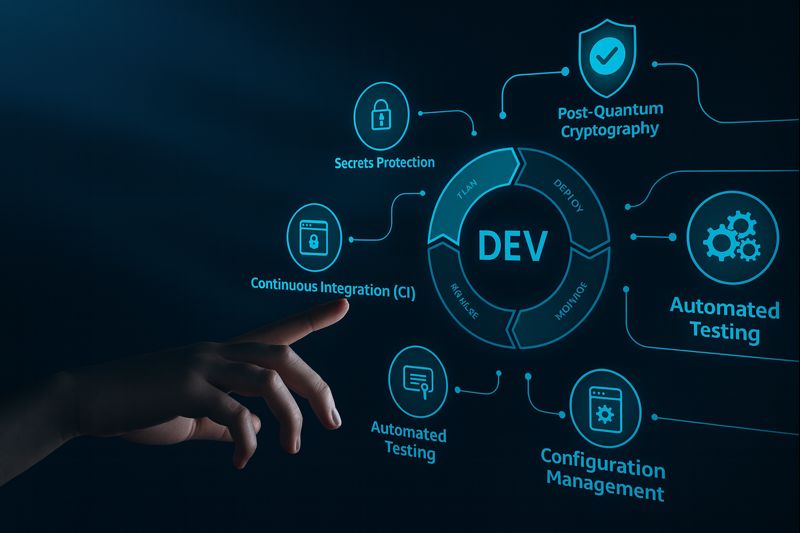
DevOps operations revolve around CI/CD systems. Many organizations are now evaluating post-quantum cryptography to protect CI/CD secrets, keys, and deployment artifacts.
The key integration areas include:
- Secrets are securely stored using quantum-resistant cryptography.
- Quantum-secure key exchange for pipeline services
- Build agents and registries can communicate securely.
- Encrypted artifact signing using quantum-safe algorithms
By gradually upgrading these components, teams can avoid disruption while improving long-term security.
Impact on security and automation in DevOps.

Automation speeds up software delivery, but it also increases attack surfaces. When encryption is weak, automation spreads risk more quickly. This is why DevOps automation needs to evolve alongside cryptographic standards.
Quantum-safe automation ensures that scaling pipelines does not increase vulnerability. Furthermore, security checks can be integrated directly into pipeline logic, resulting in ongoing cryptographic compliance rather than one-time audits.
Quantum Crypto and Kubernetes-Based Deployments
Containerized environments rely heavily on trust between components. Kubernetes clusters exchange certificates, tokens, and configuration data constantly. If these mechanisms fail, attackers gain lateral movement.
In this context, quantum crypto becomes critical for secure service-to-service communication. Future Kubernetes deployments will likely support quantum-safe certificates natively. Therefore, architects should design clusters with cryptographic agility in mind.
Role of DevOps Security Tools in Quantum-Safe Pipelines
Security tools must evolve to detect weak encryption and enforce quantum-safety standards. Modern DevOps security tools are starting to include cryptographic scanning and compliance checks that adapt to detect weak encryption and enforce quantum-safe standards.
These tools can:
- Identify non-quantum-safe algorithms in pipelines
- Monitor certificate lifecycle risks.
- Automate upgrades as standards evolve.
- Enforce approved cryptographic policies.
Quantum-safe DevOps Architecture
A quantum-safe architecture must be designed around post-quantum cryptography to ensure encryption agility and long-term protection.
The key principles include
- Algorithm agility enables future upgrades.
- Cryptographic logic is separated from application code.
- Key management is centralized, with quantum-safe options.
- Validation occurs on a continuous basis within CI/CD tools.
By following these principles, teams reduce long-term migration risks.
Challenges and Practical Limitations
Despite progress, post-quantum cryptography faces challenges. Some algorithms necessitate larger keys or greater processing power. If not done correctly, this can slow down pipeline performance.
However, research demonstrates that hybrid encryption models effectively balance performance and security requirements. During transitional periods, these models use both classical and quantum-safe algorithms. DevOps teams are therefore able to apply new standards without sacrificing productivity.
Benefits to Startups and Research Organizations
Startups frequently move quickly but overlook long-term security. Early adoption of quantum-safe DevOps builds trust between investors, clients, and regulators. It also saves money on subsequent migrations.
For researchers and academics, quantum-safe pipelines safeguard intellectual property and datasets that must remain confidential for decades. As regulations change, compliance will become increasingly dependent on DevOps security maturity.
Preparing for Quantum-Safe DevOps
The transition to quantum-safe DevOps does not necessitate the immediate replacement of all systems. Instead, teams should begin with assessment, planning, and pilot implementations. Early pilots of post-quantum cryptography help teams validate performance, compatibility, and security before full adoption.
The recommended steps include:
- Audit the existing cryptography in pipelines.
- Implement quantum-safe libraries in non-critical paths.
- Train teams in post-quantum standards.
- Monitor NIST and industry updates
This gradual approach ensures readiness without disruption.
Conclusion
Quantum computing will reshape cybersecurity, with DevOps at the center of the transformation. Organizations that adopt post-quantum cryptography now can protect pipelines, data, and software supply chains in the future.
Quantum-safe DevOps is required for long-lived systems. Instead, it is a strategic requirement for secure, scalable, and reliable software delivery in 2026 and beyond.